Today we are going to tap for Energy.
Thanks for taking part in the 30-Day Tapping Challenge!
Don’t forget to sign up to receive daily reminders so that you don’t miss a day of tapping.
If you liked today’s video, please share it with a friend.

Today we are going to tap for Energy.
Thanks for taking part in the 30-Day Tapping Challenge!
Don’t forget to sign up to receive daily reminders so that you don’t miss a day of tapping.
If you liked today’s video, please share it with a friend.
 When we are tapping there is no such thing as the “right” or “best” words to use in our tapping phrases. There are words and phrases that are useful, and there are words and phrases that aren't useful.
One set of phrases might work perfectly one day, but not so well the next.
The words we use are often related directly to what is going on in our lives, what we are feeling in our body, or what issue we would like to clear.
But it doesn't have to be that way. Sometimes the most useful words are written by someone else that we didn't even know we needed to tap on.
Over the last few weeks I have been doing a little experimental tapping work in what I call The Tapping Lab. (You can read more about the lab here.) One of the experiments that I did was tapping to an English translation of the Tao Te Ching.
In that process I came across a chapter that turned out to contain the perfect tapping phrases for me.
In this week's podcast I share my experience of tapping with the Tao Te Ching, how you can do the same with this (or any) text, and I share with you the chapter that resonated so powerfully for me.
You can even tap along with me on how to create new and healthier ways of showing up in the world.
Subscribe in: Apple Podcast | iPhone | Android | Google Podcast | Spotify | Pandora | Amazon Music | iHeartRadio
 I am always open to feedback from my readers, even when it is critical. We are all notoriously bad eyewitnesses to our own experience, so this sort of feedback can be helpful in understanding how we are perceived by others.
One piece of feedback that I have heard a number of times in the last few months is that I come across as very hard on myself.
I think this is down to two reasons.
First, in an effort to share my experience with you so that you can avoid some of the mistakes I have made, I tend to focus on my past struggles in my writings and recording.
Second, I am probably hard on myself more often than I should be!
In this week's podcast I explore the line between being overly self-critical and being honest with ourselves so that we can create meaningful change in our lives.
I then do some tapping on the issue, which I think you too may find useful.
Subscribe in: Apple Podcast | iPhone | Android | Google Podcast | Spotify | Pandora | Amazon Music | iHeartRadio
 A few weeks ago I was lucky enough to be one of the speakers at the 2022 Energy Fest put on by Donna Eden and David Feinsten. I wasn't just lucky to be in the room, but also to have the opportunity to hear presentations from world-class speakers who are doing some of the most provocative healing work out there.
One of those speakers was the transcendent Dr. Thema Bryant. I do not have the words to describe the force of nature that this woman is. Her presentation was worth the price of admission alone.
At one point during Dr. Bryant's presentation, she asked the question “Do you want to be whole?” The audience quickly and enthusiastically screamed back “YES!”
Dr. T paused, smiled a smile as radiant as one thousand suns, and asked “Are you sure?”
She then proceeded to talk about what is required to be whole. The question then wasn't really “Do you want to be whole?”, but instead “Are you willing to do the work that is required to be whole?”
That is a much deeper (and harder) question to answer.
I went directly from the Energy Fest to boarding a cruise ship with my family to sail up the Northeastern coast of the US and into the Maritime provinces of Canada. This gave me a lot of time to stare over the ocean and ponder this question.
This week in the podcast I share what that question stirred in me. I have also included some of the tapping prompted by my reflection as I pondered the process of becoming whole.
Subscribe in: Apple Podcast | iPhone | Android | Google Podcast | Spotify | Pandora | Amazon Music | iHeartRadio
 I am incredibly proud of the 24 Hours of Tapping and the fact that we raised over $31,000 for the Peaceful Heart Network.
What you don't know is that a key reason why I ran the event is because I was running away from something else. That wasn't the only reason I ran the event. It wasn't the primary reason I ran the event. BUT it was a major factor in running the event.
In this week's podcast I share with you what I was running from, why I was running, and the lessons I learned from finally facing my fears.
I hope my struggle is instructive in helping you to identify and overcome when you are running away from something important in your own life.
Support the podcast! Http://tappingqanda.com/support
Subscribe in: Apple Podcast | iPhone | Android | Google Podcast | Spotify | Pandora | Amazon Music | iHeartRadio
 One of the biggest frustrations of the tapping process is the fact that it is a process. One-minute miracles do exist, but they are rare.
Naturally, part of us would like transformation to happen immediately, while another part of us understands that healing is more often a process that takes time. When these two parts are in conflict, it can slow down your healing progress.
In this week's podcast, I share how to manage this sort of internal discord so that you can smooth the way for more rapid and lasting healing.
You can find the full tapping script of this audio as a pdf over at Tapping Q and A Podcast Scripts and Transcripts.
Subscribe in: Apple Podcast | iPhone | Android | Google Podcast | Spotify | Pandora | Amazon Music | iHeartRadio
 Recently I was working with a client who was struggling with her wish to communicate some hard truths with certain friends in her life.
She felt stuck because she knew that her friends would not like what she wanted to share. On one hand, she knew what she needed to say AND at the exact same time, she did not want to be unkind.
Sometimes we find ourselves in a situation where our desire to be authentic and our desire to be kind are in conflict.
In this week's podcast we talk about (and tap for) finding a balance between being kind and being a doormat.
Support the podcast! Http://tappingqanda.com/support
Subscribe in: Apple Podcast | iPhone | Android | Google Podcast | Spotify | Pandora | Amazon Music | iHeartRadio
 In the last few months I have been giving a lot of thought to the nature of tapping and its applications. For the longest time I have thought of tapping as an approach to creating transformation.
I am starting to change my mind about this.
Instead of being a single approach, I begin to understand tapping as a tool that can accommodate multiple approaches that are dictated by the issue we are working on, the skill of the tapping practitioner, and whether we are working alone or with someone else.
The first level of analysis involves developing my understanding of what the healing process looks like for a particular issue.
Recently, I have been describing this with the help of an analogy involving motorcycle jumps and lily pads. In this week's podcast I talk about the difference between these two approaches and how they can make all the difference in the transformation that you can achieve with tapping.
Subscribe in: Apple Podcast | iPhone | Android | Google Podcast | Spotify | Pandora | Amazon Music | iHeartRadio
 Last weekend I did a one-hour livestream tap-along and took recommendations from the viewers as to which topics we should tap on.
During that hour we tapped on:
Below you will find the recording of the live stream from YouTube as well as an mp3 version of the tap-along that you can download and take with you.
Subscribe in: Apple Podcast | iPhone | Android | Google Podcast | Spotify | Pandora | Amazon Music | iHeartRadio
 One of the concepts from my NLP training that has stayed with me is the idea that we don't emotionally respond to how the world is, but instead to how we describe the world.
An example I often use is of someone saying “Everyone at work hates me!” It is possible that everyone at work might hate the person making that claim, but it is unlikely to be everyone.
BUT if that is how work is described, then the person saying this will walk into their office with their guard up, fearing every interaction with their co-workers.
In this week's podcast we dive into the difference between need, desire, and preference, and how you can incorporate this understanding into your tapping practice to allow for more rapid personal transformation.
Support the podcast! Http://tappingqanda.com/support
Subscribe in: Apple Podcast | iPhone | Android | Google Podcast | Spotify | Pandora | Amazon Music | iHeartRadio
 One of the biggest struggles reported by tappers when tapping on their own is knowing where to start and what to say. When we sit down to tap, all we often know is that we don't feel great.
In this week's podcast I share two phrases that you can use to start any tapping session to start you off on the right foot.
When you use these two simple phrases one of two things happen next. Either the phrases will get you going and your intuition will take over and lead you to what you should tap on next OR you can keep using the phrases over and over again, leading you to the relief you are seeking.
Even more important than these two phrases is the fundamental concept of healing on which they are based. I believe that this simple concept is one of the most important foundations of any kind of healing and personal transformation work.
Listen to the podcast to hear more about this idea and how you can incorporate it into your tapping.
Listen and learn!
Support the podcast! Http://tappingqanda.com/support
Subscribe in: Apple Podcast | iPhone | Android | Google Podcast | Spotify | Pandora | Amazon Music | iHeartRadio
[Note: There is no audio-only version of this presentation as it requires the visuals to be fully understood. Full video presentation below.]
When thinking about the world, a common cliché that actually helps to guide the way I work is: Once is an anomaly. Twice is a coincidence. Three times is a pattern.
Some years ago I had a group of clients who were working hard to clear their past issues and create space for transformation, but at a certain point their progress plateaued.
We tried everything: Inner child work, timelines, wordless tapping, and anything else we could think of to try to surface any remaining memories or tailenders.
If this had only happened to one client, then I would have assumed that “we just haven't found the right issue yet.” Since there were numerous clients struggling with this same problem (see cliché above), I figured there had to be more to it.
With a lot of thought and exploration, I came to the realization that there was a habitual nature to their emotional response, meaning that the emotions they were feeling had nothing to do with whether or not we had cleared the right issues.
The emotions were just a habit!
AND because they were just a habit, tapping for a past memory or limiting belief wouldn't shift them.
Here is a short video showing how emotional habits are formed and how we can use tapping to change those habits after we clear the root causes of an issue.
Subscribe to more videos like this: YouTube
Subscribe in: Apple Podcast | iPhone | Android | Google Podcast | Spotify | Pandora | Amazon Music | iHeartRadio
 One of the characteristics I most love about my clients is their capacity for compassion and their awareness of the suffering and struggles of others. Because this is the case, my clients are helpers and healers to others.
And this is a wonderful thing!
At the same time, when we are aware of the suffering of others, we have a tendency to shortchange our own transformation.
We end up saying things like “I have it so much better than other people.”
But just because we are more fortunate than many others doesn't mean that we have to shortchange our transformation or feel selfish because we are taking care of ourselves.
The reality is if you feel (consciously or subconsciously) you are being selfish by trying to heal, then you will sabotage any efforts to create healing and transformation in your life.
In this week's podcast I am sharing a tap-along I did with one of the participants in the ID Transformation Retreat. During our follow-up sessions, a week after the retreat, one of the participants shared how selfish she was feeling for spending her time, money and focus on the retreat day.
The tapping I am sharing helped her to recognize that taking care of herself is not selfish, but actually an empowering step towards being the person she wants to be in the world.
Even if you don't think this is an issue you struggle with, I encourage you to tap along. I believe that this is one of the hidden issues that holds many of us back from creating the life we want.
On the off-chance you have this belief lurking in your subconscious mind, it is worth taking a few minutes to tap along to this.
You can find the full tapping script of this audio as a pdf over at Tapping Q and A Podcast Scripts and Transcripts.
Support the podcast! Http://tappingqanda.com/support
Subscribe in: Apple Podcast | iPhone | Android | Google Podcast | Spotify | Pandora | Amazon Music | iHeartRadio
 Last Saturday I ran the ID Transformation Retreat. Over the course of the day we had the opportunity to heal and release many past ideas and beliefs that we have about ourselves.
As the day was drawing to a close, I gave everyone the chance to ask any lingering questions. Here is what one of the participants shared:
I'm feeling a lot of emotions today. I feel like some of it is related to the tool about letting things go. I have recognized that I have all that I need within me to be the type of person I want to be. I feel like a lot of the emotions today were letting go of my old self.
AND there's a lot of grief about that. All day long there have been so many emotions and I just wanted to ask about any advice you have for dealing with this outflow of emotion.
My response was the tapping session I am sharing with you today. We tapped for letting go of our past selves, honoring who we were in the past, acknowledging the change we want, and accepting the change we are going through.
The tapping was powerful and the perfect way to wrap up the day.
As you are going through any sort of change, big or small, this is the perfect way to consolidate the process and make the change easier.
Support the podcast! Http://tappingqanda.com/support
Subscribe in: Apple Podcast | iPhone | Android | Google Podcast | Spotify | Pandora | Amazon Music | iHeartRadio
Here is something that will make you laugh. It is one of my favorite videos about healing and transformation.
Here are a few of my reflections on what you can learn from this silliness and something you can do right away in response.
I would like to introduce you to someone. Look at this cute little pumpkin!
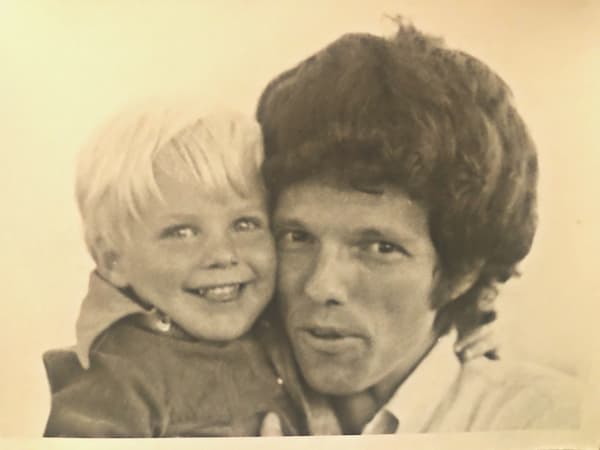
That's me when I was little. (I'm the one on the left.)
I know! It’s hard to believe. No surprise that one of my nicknames growing up was “Whitey” because my hair was so blond it was almost white.
For the last two weeks I have been spending lots of time with this little guy.
AND what I mean by that is I've been focusing my morning tapping sessions on working with myself at this young age.
I have been:
But mostly I have just been showering him with love!
In every one of these sessions I have cried at some point.
It all starts somewhere
The reason I have been spending so much time with my younger self is because of the way the human brain works.
The reason hypnosis works is because when you are being hypnotized, your brain changes states. It goes from beta waves (awake) to alpha waves (relaxed) to theta waves (deep hypnosis). In the theta state we can create deep change and transformation as we are able to rewrite what is in the subconscious mind. We are able to learn and change quickly.
Before the age of seven we spend almost all of our time in either the alpha or theta brain wave state.
It makes sense that our brain is in hyper learning mode at the ages we are doing the most learning.
The lessons that were never intended to be lessons
Because we are so open to learning at this point in our lives, we take everything we learn as true.
On one hand, it is great that we can learn so quickly at this time in our lives.
On the other hand, we can see how quickly this can go wrong.
For example:
And the list goes on.
Even when we are surrounded by well-meaning, loving adults it is possible to learn the “wrong” lessons when we are very young and don't understand the world.
At this particular stage in our lives, the lessons we learn are treated by our brains as truths, rather than beliefs that can be questioned.
The subconscious gets its way
Because the mind works this way it can cause frustration and pain.
It puts us in a situation where our conscious mind can see the world through the eyes of a thoughtful adult, while the subconscious mind sees the world through the lessons we learned when we were young.
AND (and this is a big and) the subconscious mind always wins.
Have you noticed how seldom New Year's resolutions work? That's because they are an act of the conscious mind trying to change the beliefs of the subconscious mind.
I've been spending a lot of time with the little guy above because I am trying to uncover and understand all the lessons he learned that no longer serve me.
Wanting to change is not enough
If we truly want to change our lives, we need to do more than a little tapping here and there. We also need to change the beliefs we have about ourselves and the world.
I created the ID Transformation Retreat with exactly that in mind. I want you to be able to participate in an experience where you can uncover and unpack the beliefs that are keeping you stuck and holding you back from living a life you love.
This event will be different from most of the events I run. Usually my emphasis is on teaching tools and techniques that you can use later when tapping on your own or with clients.
At the ID Transformation Retreat we will be doing HEAPS of tapping!
Because this isn't about learning, it is about healing.
Don't get me wrong, you will still learn a lot, but that is not the main aim of the event.
Here's how the ID Transformation Retreat will work:
Before the event you will receive a series of short videos from me. Each video will teach you a tapping tool you can use to do deep work on your own. Sharing these ahead of the event means I won't have to spend as much time teaching during the retreat. It will take you less than an hour to watch all the videos AND doing so ahead of the event is not a prerequisite. Instead, they are designed to set the table for those who are interested in the hows and whys of the tools we'll be using together at the retreat.
During the retreat we'll unpack known and unknown limiting beliefs and we will transform and heal them. I will be tapping with volunteers one-on-one, we are going to do loads of group tapping, and there will be a chance to learn from the insights and transformation of others.
After the event I am going to hold a bonus session where you can ask any questions that arise after the event, and we'll do more tapping.
You have seven days to listen to the replays so that if you can't join us live, you can still participate AND even if you are there live, you can tap to the sessions again and again.
All the details
Here are the details:
Notice that the bonus session is at 8 PM on Friday night. I planned this especially for those who live in Asia, Australia, and New Zealand who don't want to stay up all night to tap with me on Friday 23rd. Everyone is welcome to join the bonus session, but I wanted to make sure I did something special for those on the other side of the world.
The ID Transformation Retreat only costs $247.
That's less than the cost of working with me for an hour AND you will get a full day of transformation for that price.
You can sign up here: http://idtransformationretreat.com/
Limited Space
I want this to be as personal of an experience as possible, so I am limiting registration to just 100 people. Once 100 people have registered, registration will close.
Don't miss out: http://idtransformationretreat.com/
If you have any questions, reply to this note and I get right back to you.
I really hope you can join us. It is going to be an amazing day of healing and transformation.
Gene
 Although you can learn tapping in just a few minutes, it can take a lifetime to uncover all the subtle nuances in its application.
Over the course of years of doing thousands of tapping sessions with clients, I have learned that there are few simple steps we can take at the beginning of a session to make the healing process quicker and smoother.
A few weeks ago I gave a presentation at the Spring Energy Event on 5 simple things that you can do to begin a tapping session to get the most out of it.
This week's podcast is that presentation. All of the tapping phrases that I talk about during this presentation can be found in this download
Subscribe in: Apple Podcast | iPhone | Android | Google Podcast | Spotify | Pandora | Amazon Music | iHeartRadio
 Tapping is an amazing tool that can help us to turn our mood around when we are going through a rough patch. It can also be powerful enough to clear out deeply rooted traumas and limiting beliefs.
When tapping for these types of issues the approach is fairly straightforward. Sometimes we are too close to the issue to tap effectively on our own and then the help of a skill tapping practitioner can be invaluable. Even when this happens, the process of the work itself is easy to understand.
There are other times where we just don't know where to start, such as when we hit rock bottom emotionally. This is way more than a low mood or a couple of challenging days. Hitting rock bottom means feeling overwhelmed by negative emotions, and any relief provided by tapping is fleeting.
In this week's podcast I share a straightforward four-step process you can use when you hit one of these patches. It's a useful process for rough times in general, but particularly potent when you are in despair and feel unable to bounce back from rock bottom.
Subscribe in: Apple Podcast | iPhone | Android | Google Podcast | Spotify | Pandora | Amazon Music | iHeartRadio
In an effort to make the research around tapping more accessible to the general public David Feinstein, Ph. D., is writing summaries of these studies. You can find all the summaries that have been shared so far here.
 In more than 120 clinical trials, energy psychology, which is the umbrella term for the Emotional Freedom Techniques, Thought Field Therapy, “tapping, “and related approaches, has been shown to deliver significant improvements across a wide range of psychological and physiological conditions with striking speed and durability.
But despite impressive results in clients with issues ranging from PTSD and depression to cardiovascular and immune disorders, many therapists and clinicians dismiss the approach because of the vague and often controversial use of the term energy in energy psychology. Read more>>>
About David: DAVID FEINSTEIN, Ph.D., is a clinical psychologist and a pioneer in developing innovative therapeutic approaches, leading to nine national awards for his books on consciousness and healing. He and his wife, Donna Eden, have built the world’s largest and most vibrant organization teaching energy medicine. Their latest award-winning book, The Energies of Love, achieved best-seller status on the NY Times Relationship List. David has served on the faculties of The Johns Hopkins University School of Medicine, Antioch College, and the California School of Professional Psychology.
 If you are in any way familiar with tapping, then you have repeatedly heard how important it is to get to the root cause of an issue. The thinking is that by finding and dealing with the root cause, we will be able to take care of the whole issue.
Much like if you kill the roots of a plant, the entire plant will wilt and die.
This teaching makes perfect sense but I think most people make a critical error when trying to implement it. And that mistake is that they focus only on the root cause, to the exclusion of everything else.
I believe there is an essential step we should take before diving into the root cause. Adding this step means we can clear root causes more quickly AND enjoy longer lasting results.
In this week's podcast I talk about what I believe is a key step to transformation and how you can implement it in your own tapping work right away.
Support the podcast! Http://tappingqanda.com/support
Subscribe in: Apple Podcast | iPhone | Android | Google Podcast | Spotify | Pandora | Amazon Music | iHeartRadio