• Skip to primary navigation
  • Skip to main content
  • Skip to primary sidebar
  • Skip to footer
  • Leave A Tip

Tapping Q & A with Gene Monterastelli - Get the most out of tapping and EFT

  • Learn Tapping
  • Podcast
  • Video
  • About Gene
  • Work w/Gene
  • Archive
    • Every Post Ever
    • Q&A
    • Podcast
    • Videos
    • Tools
    • Tap Along
    • Sessions
  • Events
  • Contact Us

Video Review Of Lessons Learned While Tapping In East Africa

February 13, 2023 by Gene Monterastelli

We took about an hour to reflect on our experience in East Africa with the Peaceful Heart Network. We give a short trip recap PLUS we shared what surprised us, what inspired us, and what we learned.

Make sure you join us this year July 14th and 15th for this years 24 Hours of Tapping. Sign up for updates at 24HoursOfTapping.com
Filed Under: Notes Tagged With: Peaceful Heart Network

Day 10 – Tapping With Refugees

February 2, 2023 by Gene Monterastelli

Today we spent time in Bidi Bidi Refugee Settlement, which at one point was the largest refugee camp in the world. As of 2018, it became the second largest behind the Kutupalong refugee camp in Bangladesh.

There are over 250,000 people living in Bidi Bidi who have fled the ongoing civil war in South Sudan. That is half the population of the entire state of Wyoming, where I grew up.

Bidi Bidi is in the northernmost part of Uganda, where the climate is hot and dry; it was over 95 degrees while we were there. Before the arrival of the refugees, there was just open land and a few small villages.

Our guide for our visit was Pastor John Obonyo. Pastor John is an amazing man who has given his life to serving the people in the refugee camp. In addition to his pastoral work, he has run over 40 tapping trainings, in which he has trained more than 6000 people in TTT, so far.

Who embraces tapping
One of the most fascinating details I learned from Pastor John was how excited the local Christian pastors of various different denominations were about learning to tap and sharing it with their congregations.

The reason they were so excited about tapping has to do with something that is both spiritual and cultural. In the part of the world where Pastor John is working, there is a deep-seated fear of demonic possession. AND people fear that contact with someone possessed can pass on the evil to others. This means that people who are believed to be possessed are ostracized from society.

Pastor John shared that in many cases, people were actually struggling with PTSD or other symptoms of severe stress or trauma. When family members come to him with a possessed loved one, he first taps with them. If the tapping works, no further intervention is usually needed. If it doesn’t, he then reaches for his spiritual tools to provide help.

I find it so fascinating how much context impacts the way in which something like tapping is embraced. In the United States, in broad, general terms, one of the places that tapping is least accepted is in Christian communities because of the perception that energy work could be spiritually dangerous. And at the exact same time, the pastors of North Uganda see tapping as a vital tool to help them best serve their spiritual communities.

Presentations and reports
Once again, the local community shared with us personal stories of the power of tapping in their lives. I can’t even imagine the struggles of the lives of the refugees, and I continue to be astounded not just by the magnitude of the suffering, but also the overcoming of that suffering.

They also shared songs and dances they had created about tapping.

Accepting and giving dignity
One of the conversations we had with the leaders of the community was about the outside aid refugees received from the UNHCR, the United Nations refugee agency, and other NGOs. As time has passed, the amount of support has diminished. Everyone in the camps receives rations of corn, beans, and oil every month, but the size of those rations has decreased.

At the end of the presentation, Pastor John and the other community leaders insisted that we join them for lunch. It is a precarious position to hear people talking about their struggle to feed themselves and their families, which is then followed by an insistence that we join them to share a meal from their very limited rations.

In these situations the best thing to do is to say “yes” with a smile. By accepting their gift of lunch, we hoped that we also extended the dignity of allowing them to take care of us. It was a simple and tasty meal of rice, potatoes, chicken, and stewed greens.

We found it humbling to be served in such a way.

Odds and Ends

My buddy
This sweet smile belongs to Emanuel, who clung to my side while we were waiting for lunch.

3 minutes, not 15 minutes
Our local organizers expressed the regret that we could only be with them for three hours of presentations and sharing, because of the five hours of travel ahead of us after our visit.

They wanted us to hear all the stories of transformation. They wanted us to know about all the healing. They wanted us to appreciate how far they had come.

In an effort to keep everyone on track, there was a lot of reminding speakers how much time they had. At one point, the MC said “And we are now going to hear testimonies that are only 15 minutes long each.”

Before the testimony could begin, our friend Placide, who has led many of the trainings in the region, grabbed the microphone and said, “The testimonies won’t be 15 minutes, but can be 3 minutes instead. All you need to do is share what you were struggling with and how you are doing now!”

As someone who has spent more than three decades attending retreats where people share their personal stories of healing and overcoming, I appreciated the firm hand they had on the wheel, as it is easy for short stories to turn into not-so-short stories.

Making ends meet
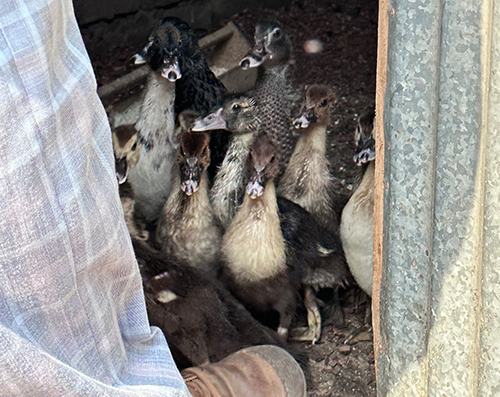
One of the things Pastor John does to support his family is raise ducks, which he then sells. He has a solar-powered incubator in his office for the eggs,which is a simple, but ingenious, set-up. A small shed, a solar panel, and a little time was all Pastor John needed to support his family and his work. When asked why ducks instead of chickens, he told us that ducks are preferable because they are more resilient to disease than chickens.

Tear Tally
By this point in the trip, any time I think about the people, the work, the struggle, the overcoming, my travel companions, or a cold bottle of water, I am brought to tears. We have moved beyond adding tears to the tally…the #teartally = all the time!

Filed Under: Notes Tagged With: Peaceful Heart Network

Days 6, 7, 8 and 9 – All the animals

January 30, 2023 by Gene Monterastelli

Apologies for the delay in providing updates, which is down to a couple of reasons.

First, we have spent a lot of time traveling in the last four days; we have done over 20 hours by road and taken a flight from Rwanda to Uganda.

Second, we haven’t worked directly with any communities for the last few days as we spent a full day touring around the Murchison Falls National Park.

We have just arrived in Mayo, in the north of Uganda near the border with South Sudan, where we will see tapping in action tomorrow in the refugee camps.

So, today’s update is going to be all odds and ends.

My breaking point
I reached my breaking point on Saturday.

I was tired and overwhelmed. I didn’t have the mental or emotional capacity to have another conversation about failed governments, uncaring people, complex trauma, or even the amazing way in which people have managed to overcome suffering in the face of enormous difficulties.

On one level I can be gracious with myself in knowing that this is emotionally and physically hard. I am ten time zones off my normal schedule, we are constantly on the move, I haven’t been making the best eating choices, and there is new stimulus and information to digest around every corner.

At the same time, I was reminded of a comment I heard someone make around racism in the United States.

Person A said, “It is just so exhausting to have to think and talk about racism all the time.” To which Person B replied, “Now imagine how exhausting it is to live with it every moment of every day.”

It is emotionally exhausting to think about everything that is going on in the communities we are serving AND that is nothing in comparison to the daily reality of their lives.

My physical and emotional frailty (because I am human and not made of steel) is a reminder that not only do I need to keep working to make change, I also need to be someone who is sharing these stories with others, so that they too can contribute to making positive change in the world.

Fortunately, after a night's rest, a hot shower (our first of the trip), and a few restorative hours of downtime in the car listening to podcasts, I'm back in fine fettle.

Messing with podcast producers
One thing podcast creators often obsess about is their download stats. I have always been fascinated by where in the world people are listening to my podcast. When we have access to wifi, I have been downloading my normal collections of podcasts about sports and culture. It tickles me to imagine podcast producers poring over their stats from last week and seeing their first-ever downloads from Rwanda and Uganda!

Lions and tigers and bears oh my
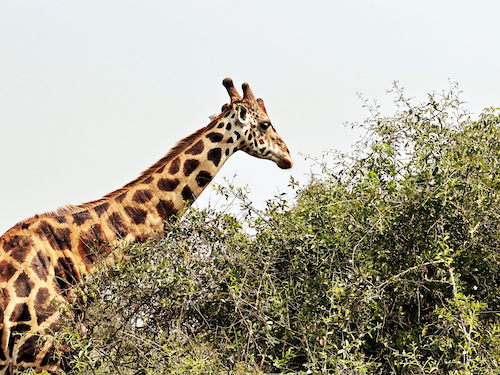
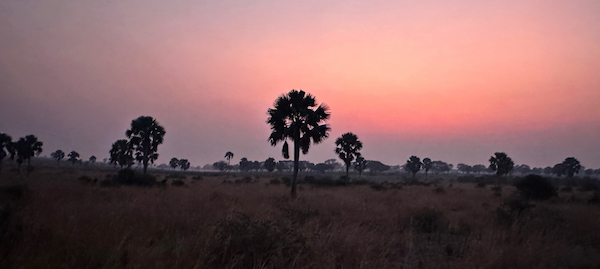
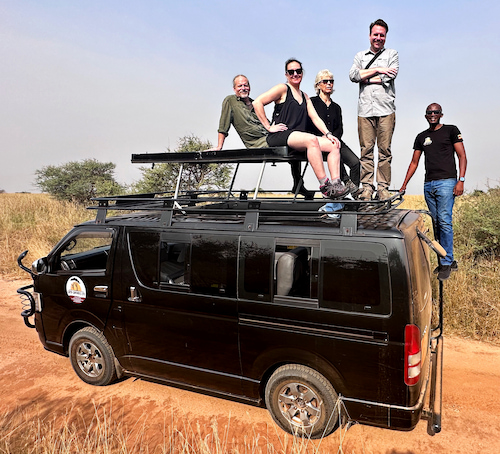
Really it was lions and hippos and giraffes and elephants and warthogs and water buffalo and antelope oh my. We were lucky enough to spend a full day touring Murchison Falls National Part.

On arrival we were warned to stay out of the pool after dark and to stick to well-lit paths to avoid running into a hippo. It was amazing to think it was more dangerous to walk home from dinner in the park than it was to work in a prison.

Henry, a park ranger, was hired to spend the day with us and to share all sorts of fascinating facts about the park and the animals.

To see the animals coming out to drink at dawn, we left our accommodation at 6 AM and didn’t get back until early evening.

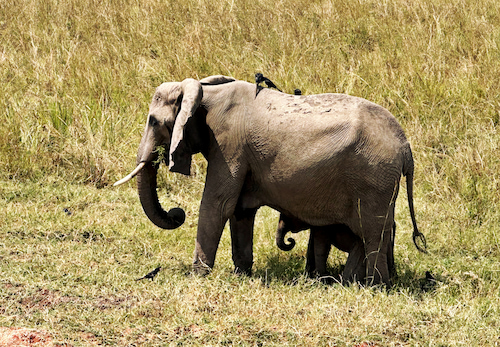
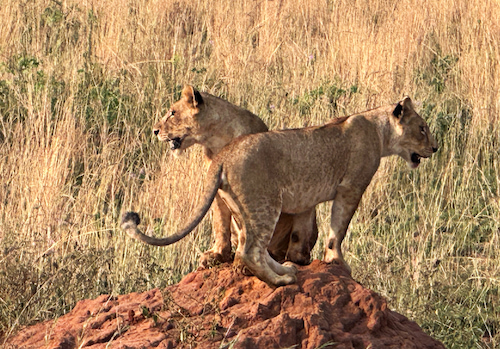
Families of elephants and giraffes were everywhere, which were so magical and majestic. We also spent about 45 minutes watching a pride of five lions as they enjoyed the spoils of their morning hunt. There were two adults, two juveniles, and one younger juvenile, who went from eating to wrestling with his siblings.

There were more species of antelope than I can remember, ranging in size from something like an elk, to fully grown at just twenty inches tall. The little ones were ridiculously cute, but we decided that US customs would not appreciate us bringing home a mini antelope, and I am guessing they wouldn't love a New York winter either.

Birds were a whole other fabulous category of delight, from small ones of the brightest electric blue you can imagine, to pairs of giant hornbills that looked like dodos.

In the afternoon we took a river cruise up the White Nile to Murchison Falls. On the way we passed pods of hippos and elephants drinking from the riverbank as we floated up to the foot of the falls.

I think this would be a good time to mention once again that nothing on this trip was paid for by the money we raised during the 24 Hours of Tapping. All our expenses are being covered by us, so rest assured that your money did not fund us seeing elephants and giraffes in Africa.

Here are a few photos and videos from the day.

At breakfast this morning my sister and I were reflecting on the trip. She said, “I’m glad we got to spend time in the park, but I am not going to remember the animals. I am going to remember the people from our trip.”

It really was a lovely break and set us up for the next segment of our trip.

Driving to Moyo
As we were leaving our national park lodge, the person helping Laney with bags asked where we were heading next. When she told him that we were on our way to Moyo he was completely confused as he could not imagine a Mzungu (term for foreigner or white foreigner) going there. That's because the only non-refugees and non-Ugandans in that part of the country are international aid workers.

Our journey to Moyo took a full day. We crossed the White Nile in a ferry, but it was mainly by car and included more than three hours on rough dirt roads where we made slow progress.

As we were bouncing up and down, avoiding rocks and potholes, our driver Pascal turned to me and said with the warmest smile “That is a Ugandan back massage”.

We are staying at a small boarding house run by the Catholic church, which is funded by a parish in Spain. When the aid effort started for the refugees in this part of the country, there were no hotels or rooms available to rent so it has served a great need.

It is clean, quiet, and calm.

I am off to rest as we have a full day ahead tomorrow with over 400 people showing up for a tapping training.

Filed Under: Notes Tagged With: Peaceful Heart Network

Day 5 – Musanze Prison

January 22, 2023 by Gene Monterastelli

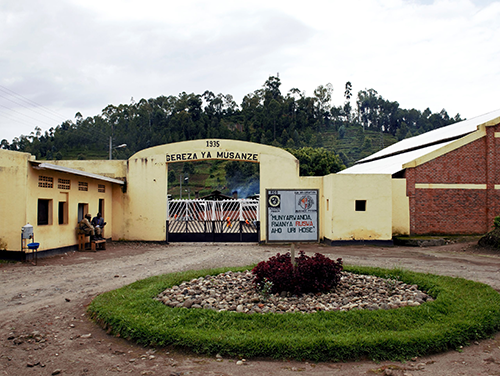
Today we spent the bulk of the day at Musanze Prison.

The prison houses both men and women, in separate sections. The area that we had access to was the main courtyard, which has a volleyball net in the middle, a large covered area for gatherings, open access to the kitchen (where all meals for all 5000 inmates are made), and is lined with a number of sleeping quarters.

I haven't been in a lot of jails, but I have been in more than most. The vibe of the courtyard was different from any prison I have ever visited. Not that it was great, it was a prison after all, but I was struck by the sense of calm. The interaction between the correction officers and inmates was kind. There was very little noise, rushing or hostility.

Returning
One of the people accompanying us was our friend from Day 4, Callixte. As you may recall, Callixte was wrongfully imprisoned for five years. As we walked in, he froze for a few seconds and just looked around. He wasn't scared and the warmth never left his face, but he was having a moment as he returned to the place where he served his sentence.

Formality part 1 and the director
Every event we have done so far has included a bit of formality. This has typically been a welcome address from someone in charge, a prayer, and a chance for us to introduce ourselves formally to the group.

This happened twice in the prison.

First, we were escorted to the director's office. He was a tall, upright man dressed in a crisp military suit and seated behind an imposing desk. He introduced himself and his staff, and we introduced ourselves. Again, in a slightly more formal manner than I am used to.

As formal and impressive as the director was, there was a sense of calm and groundedness in the room. He moved with grace and seemed larger than he actually was, but not in any sort of intimidating way.

Whenever one of the correctional officers approached the director, they saluted, but did so with a large smile. It was clear that they both liked and respected him.

Formality part 2 and the inmates
After spending 15 minutes with the director he escorted us over to the outdoor pavilion where 101 inmates awaited us.

We were seated on the stage, with 61 male inmates on our left and 40 female inmates on our right.

We were not allowed to take photos in the facility, but they provided this one (and we hope there will be others to follow):

The formalities continued.

We were first greeted by one of the inmates, who thanked everyone for coming by name.

Our friend Placide (I will tell you a lot more about him later) translated for us. Placide has been traveling with us throughout our trip and was the primary facilitator for the original tapping classes. Musanza is his hometown and he visits the prison at least once a month.

The inmates were gracious and welcoming as each of us was introduced, but when Placide was introduced, the inmates went crazy. Their love and respect for him was clear; they just adored him.

With each introduction there was applause and the inmates made a sound of approval that made me think of the wind blowing through a reed and somehow forming a musical note.

Next, one of the inmates, who was a pastor, led the group in an opening prayer, which was followed by a song of welcome and dancing. The inmates were all dressed in orange. The four dancers, two male and two female, draped traditional cloth over their prison garb as they danced.

The report
One of the female inmates then reported on how the tapping training had been going in the facility. Here's what she told us:

  • 61 men and 40 woman have completed the training
  • They first learned the consequences of stress and trauma on them, both mentally and physically
  • They learned how to identify stress and trauma in others
  • They learned active listening skills
  • The trainees learned that they should first take care of themselves before they try to help others
  • They were appreciative of the materials that had been provided, which included a counseling tent in which the trainees took turns offering help to any inmate who wanted to talk or tap
  • They were super grateful for their PHN t-shirts that had been received because these were like a uniform that let the other inmates know they were helpers
  • Each trainee was also given two copies of the TTT book in their native language of Kinyarwanda for their continued study and so they could help others as well

She then reported that the goal of each one of the trainees was to create small groups with other inmates and to have each of the trainees share tapping with at least 10 other inmates.

AND she was very happy to report tapping had been taught to more than 1000 inmates.

Song of healing

One of the inmates was then invited to share his healing journey, for which he had written a song.

He held a small block of wood that had a number of strips of metal attached to it of different lengths. Pushing down and releasing the metal strip produced a musical note, in the same way as a music box strikes a note.

His song was about his pain and suffering, learning to tap, and healing. #teartally

Here is the song, captured as best as I could using the voice memo app on my phone.

Sketches
Next, the inmates performed two sketches that they had written, both about how to identify someone in distress and how to teach them tapping.

They had worked very hard on them and were really proud of their work.

It was SO SO awesome!

Song of tapping
The group then sang a song they had written that included the tapping. Because singing and dancing is an important part of many Central and East African cultures, it is a natural fit.

While all this was going on, the small children were dancing and tapping along and at one point I noticed one kid correcting another's tapping technique.

The kids
Yes, you read that correctly. There were children there too.

Mothers who are incarcerated are allowed to keep their children with them up until the age of three. There was a special wing in the women's area for inmates with children, which also housed a nursery where some of the inmates teach.

Like the other places we have visited in Rwanda, the kids were allowed to be kids. They wandered around the group, climbed in and out of different inmates' arms, and the correctional officers always greeted them with waves and smiles.

They were noisy, like kids, but not disruptive.

This is the moment when I simply run out of words (#teartally). On one level it was amazing to see how the kids were being cared for and loved by everyone in the facility. And at the same time, I was thinking about that moment when they turn three and are sent away to another part of the family, leaving their mothers and everything and everyone they'd known in life up until that point.

One of the reasons I did work in the prison system in the US was because I felt that if we could help the incarcerated with their anger, then they were much less likely to end up back in prison, which meant I was also helping kids to get their parents back.

When someone is incarcerated, those that suffer in their absence are often overlooked. It is an act of trauma that is inflicted on children, because of no fault of their own, and the system creates a cycle of trauma that can ripple through generations.

And this is when I run out of words. I have no clue what to do about any of this, other than healing systems, healing communities, and healing family members, which I believe is what we must be committed to doing.

Each individual who can experience deep healing is an opportunity to halt the domino effect of generational trauma.

All the emotions
The formal presentation ended. The director once again thanked us for all the support of his facility and then we headed for the gate.

I didn't realize the human heart and head were able to express so many emotions at the same time.

I was flooded with gratitude…hope…anger…shame…helplessness…encouragement…love…kindness…sadness, and an overwhelming wave of other emotions that I can't adequately describe.

Sometimes it aches so deeply to be human.

Sometimes you just want to not feel anything.

Sometimes you need to feel everything all at once.

Sometimes these feelings become the fire for the action to be taken next.

Odds and ends

You might want to take a deep breath before reading the next bit, as it is a bit of a change of pace.

Wyoming shirt
While walking back to the hotel I passed a child of about eight who was wearing a t-shirt with the Wyoming (my home state) flag on it. It happened so quickly I didn't have a chance to grab a photo.

Serving in the DRC
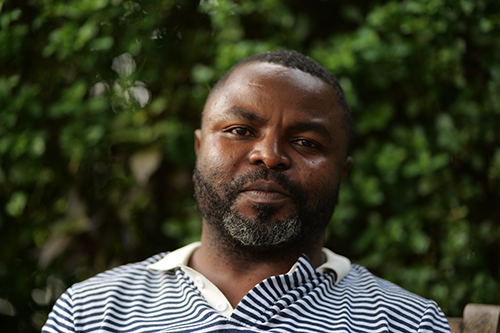
After our time in the prison we gathered for a late lunch. We were joined by Germando Kagomba Barathi (pictured below). We figured out that Germando speaks at least 11 languages, seven of which are Congolese. He is a medical nurse and has served in some of the scariest places in the world (most often local areas controlled by warlords).

I feel bad turning Germando into an odd or end as his story, life, and work deserve a full post. He arrived in Musanze from the Congo and he was on his way to attend an interview for work with Doctors Without Borders (he got the job!). He is a great asset to the organization as he is a nurse, speaks so many languages, completely unflappable, and full of energy and positivity.

Over lunch he shared stories with us about teaching children how to tap, many of whom had been taken from their families by local militias. He talked about the power of NOT having them share their stories, but instead just tapping because retelling a story would re-traumatize them.

In the face of so much struggle, there is so much hope.

Explaining the American Medical System
Over lunch my sister tried to explain the US healthcare system to two Rwandans.

They simply could not believe their ears – to the extent that their eyes were popping and their jaws went slack in astonishment.

At one point I think Pius thought that my sister Laney was joking. She was not.

I am here
One of the things we have become accustomed to is the Rwandan approach to start times and meeting times.

Let's call it a relaxed approach.

Imagine you are meeting someone, you have arrived, and they have not. You call them to ask where they are, so you can have a sense of when they might arrive, and they will reply “I am here.” When they say that, they are saying “I am where I am” which is often followed by “be patient”.

Luckily everyone in our group is able to roll with that. It means more time to sit and enjoy a nice cup of coffee while looking up at the volcanoes.

Tear Tally
The tear tally is now up to 11, but two of those were during the writing of this post.

Filed Under: Notes Tagged With: Peaceful Heart Network

Day 4 – Helping the Helpers

January 20, 2023 by Gene Monterastelli

View this post on Instagram

A post shared by Tapping Q and A (@tappingqanda)

See all of the updates from our trip here.

Yesterday, following our visit to the Dian Fossey center we settled in the town of Musanze in northwest of Rwanda.

After an early breakfast we made our way to the Bigogwe Sector, Kijote Cell to spend the day with Callixte Rudakenga.

Here are a couple of (not brilliant) photos I took on the drive:

My words feel inadequate in describing this man and his journey, but here is my best shot.

Callixte was wrongfully imprisoned for five years. Eventually he was released, but while he was in jail he found a Peaceful Heart Network flyer from a workshop they had previously offered to inmates. He was inspired to reach out to the PHN via WhatsApp and shortly afterwards started his course of study.

Later that day, as we were driving to see the lake on the border with DRC, we drove past the prison where Callixte had spent five years. He happily shared what it was like to be in the facility, without a sense of anger or bitterness.

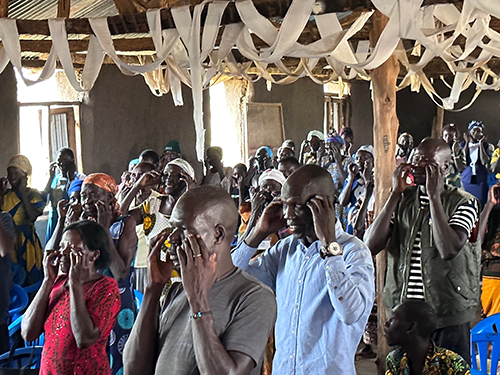
The reason we were spending the day with Callixte was because he was running a Trainers of Trainers course where he had been teaching TTT (the version of tapping taught by the PHN) and we were lucky enough to be able to participate in the final day.

The class was filled with healthcare and Red Cross workers.

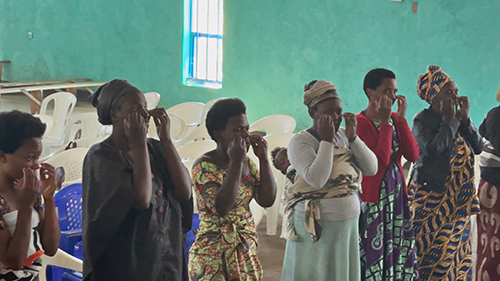
I wasn’t able to capture it all, but this is how we were greeted by the class:

This welcome has set a high bar for how I hope to be greeted every time I enter a room in future!

We participated in some of the class teaching TTT and did some practice rounds with the students.

We then heard a number of testimonies about tapping from the students, as many of them had participated in prior classes.

Here are just a few of the things the students said:

  • After tapping I can feel my body. I can feel my breath. It feels like praising God.
  • It puts you in a state of calmness and safety.
  • I can focus outward, because the noise in my head has stopped.
  • There are lots of things bouncing around my mind…then they all go away.
  • When I have a headache and I want to sleep, I start tapping. I never finish because I fall asleep tapping.
  • My infant was crying. I tapped on him. First he laughed, then he fell asleep.
  • I use tapping as my sleeping pill.
  • Just by thinking about tapping, I feel better. I don’t even have to do it. It is the best thing for changing my mood.
  • By calming my mind, it allows me to learn new things.
  • My kids are more focused in class.
  • I tap three times a day. I went from sick to having more energy than I know what to do with.
  • When I have a question that I don’t have an answer for, I tap. It helps me to think more clearly and solve problems.
  • My friends were suspicious because I was so different.

The rain
One of the women who gave her testimony talked about how before she learned tapping it sounded like it was raining, even when it wasn’t. It was a comment that needed some context for us to understand fully.

I grew up in the high, dry desert and I have always loved the rain.

In the 1990s I remember going to a reading by a poet from Cape Verde, an island nation off the coast of West Africa. Even though it's in the middle of the ocean, it doesn’t rain much there and in the local language, the word for rain and the word for hope are the same (my memory says the word is chuba, but I could be wrong). Because it rains so infrequently there, when it does, it brings new life and hope at the same time.

For those who lived through the Rwandan genocide, the opposite is true. It rained a lot during the 100 days in 1994 when the genocide took place, so many Tutsi people associate rain with trauma, pain, and death.

The woman sharing the story about hearing the rain, even when it wasn't raining, was really talking about the terror she associated with the rain that fell constantly during the genocide.

After learning tapping, not only did she stop hearing the rain when it wasn’t raining, but she was no longer terrorized by the rain or her past.

Their stories
For me, the most heartening part of the day was that when the participants talked about their experience with tapping, they first talked about how it had helped them and their families AND also in their work.

I love the fact that tapping isn’t just a tool that is helping them to serve their community and patients better, but something that allows them and their families to heal too.

How it all came together
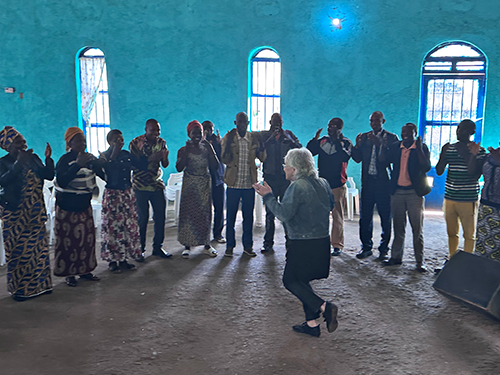
So there we were. Sitting in a church in the northwest of Rwanda tapping, laughing, singing, and dancing.

The day happened because:

  • Callixte, a wrongfully imprisoned man, decided to do good in the world
  • The Peaceful Heart Network had done the hard work to get into a prison to make the lives of inmates better
  • Callixte decided that every person in his part of the country should have access to tapping
  • And YOU!

I didn’t know it until the middle of the day, but this particular training happened as a direct result of the contributions from the 24 Hours of Tapping fundraiser we ran back in July 2022.

If you donated even a few dollars, I want you to go back and reread the (abridged) bullet list above listing just a few of the benefits of knowing how to tap. Because of your contribution, the lives of 33 health care professionals and their families are better, their patients' lives are better, and the good ripples out even further than that.

One of the participants talked about how he had taught his children to tap, and his children had in turn taught all of their friends.

Another woman told the story of being left for dead in the genocide. Learning to tap has meant that she no longer experiences nightmares every night, and she is also sharing tapping with others.

You are a part of that amazing transformation!

Poems
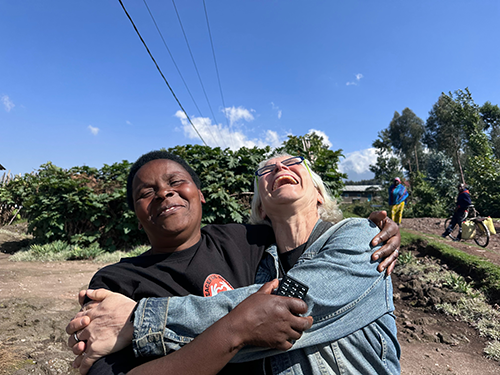
In addition to testimonies, we have also heard poems. A woman who shared a poem about her healing asked Ulf and Gunilla to stand next to her as she read the poem. When she got to the line about gratitude for each of them, she paused and hugged them.

She didn’t just want them to know how much learning to tap meant to her, but she wanted them to feel it in the form of hugs. (Yes, this did add to my tear tally.)

And then we celebrated
After the sharing of reflections and testimonies, we celebrated.

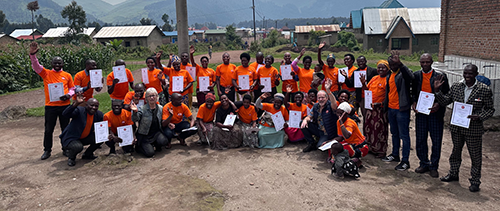
All the participants received their certificates and PHN t-shirts. We took photos, and the participants also took photos, all wanting a record of themselves holding their certificates next to their friends.

Here is a group photo.

And then we ate!

Odds and ends

Didn’t register, but were welcome
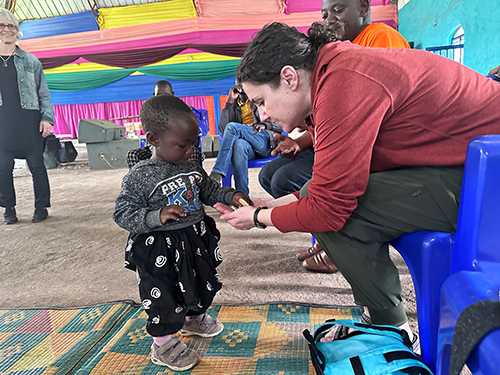
At the training there were also a number of young children who were so much fun to have around. They weren't quiet, because they are small children, but they weren't a distraction either. Over the course of the day they were passed from person to person, with everyone being helpful and happy to see them.

Here is my sister making friends with the cutest little pumpkin.

I don’t always tap
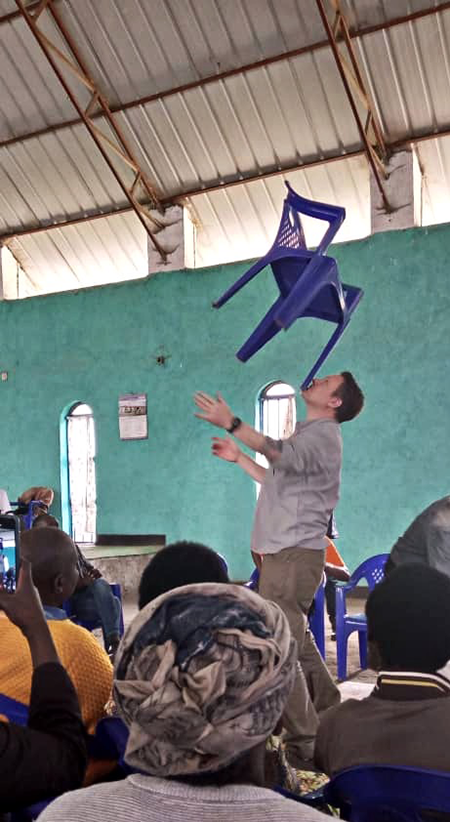
In addition to the tapping training, I pulled out a few tricks, which was also fun.

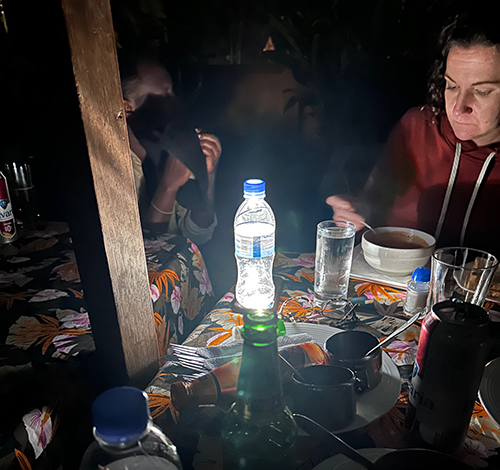
Dinner by phone light
On Wednesday night there was a blackout while we were having dinner. It's not something that happens all the time, but is also not unexpected. It was absolutely pitch black and still, so we improvised with a water bottle and cell phone light to create candlelight.

Tear Tally
On Day 4, the tear tally is up to six, but all of my tears today were those of huge gratitude.

Filed Under: Notes Tagged With: Peaceful Heart Network

  • Page 1
  • Page 2
  • Page 3
  • Interim pages omitted …
  • Page 15
  • Go to Next Page »

10 Steps To Stop Self-Sabotage

Get your FREE 10 step guide to using EFT to stop self-sabotage in your life.

Search Tapping Q & A

Meet Gene Monterastelli

Gene MonterastelliGene Monterastelli is a Brooklyn based tapping practitioner. In addition to working with individual clients and groups, he regularly writes and records about how to use tapping to move from self-sabotage to productive action.
Gene’s Full Bio & Services


Subscribe via: Apple Podcasts | Google Podcast | Android Phone | Spotify | Pandora | Amazon Music | Audible | iHeart Radio | Castbox | Alexa | Stitcher | TuneIn | Deezer | aCast | Himalaya | Overcast | Luminary | RSS
Visit the complete Podcast Archive

Apple App | Google/Android App


This book is not just about EFT and tapping for anger. The book contains some of the most comprehensive step-by-step tapping tools that can be used for all emotions and can be added to your tapping tool set right away.

For every book purchased, four inmates will also receive a copy of the book.

For every book purchased 4 inmates will also receive a copy of the book.

Paperback | Kindle Version

Copyright © 2026 · Refund Policy · Terms of Use· Privacy Policy