 Theoretically we all want to be our authentic selves and show up in the world as we actually are.
But for most of us it's just not that simple. From past experience we have learned that there are some situations where others don't understand us, or we have been judged harshly for being our authentic selves.
That makes us reluctant to present ourselves in a way that will be judged by others.
In truth, being our authentic selves is not an all-or-nothing proposition. We can choose how much of ourselves to share, with whom we share it, and when we share it. This will ensure we are doing in a way that is safe for us.
This week I have a tap-along audio and tapping script that will help you to feel safe as you find the ways in which you want to share your authentic self.
You can find the full tapping script as a pdf of this audio over at Tapping Q and A Podcast Scripts and Transcripts.
Subscribe in: Apple | iPhone | Android | Google | Spotify | Pandora
 As many of you know, I also run the member site the
  Tapping is a tool that is both relatively simple to learn and implement, but deceptively complicated to master.
  The basics of tapping are so simple that they can be taught in mere minutes.
 It is great that we have people in our lives who want to be helpful. They are willing to offer their time, attention and advice to make our lives better.
 It is difficult for us to see the people we love suffer but often we don’t consider the consequences when we rush in to help. Our need to bring peace and comfort can override all other thoughts and considerations. This is not always the healthiest choice for us in the short and/or long term.
 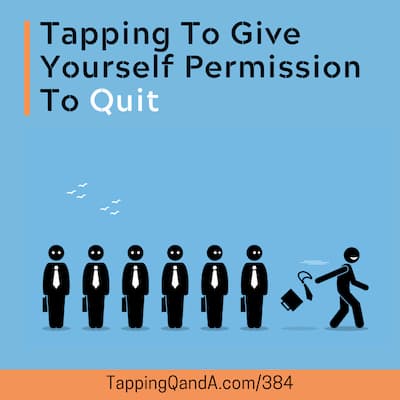 The idea of quitting comes with a lot of cultural baggage. Quitting is often seen as failure, or giving up, or as a sign of weakness.
 This is a technique that I developed from some of the resources from
  If you have been following me of any length of time online, then you know how much I love goal setting.
 While on retreat a number years ago Russ Hudson said, “We must be in touch with the mind, body, and spirit in order to be candidates for transformation.”
  Human beings are social creatures.
  I am a huge proponent of goal setting.
  With some issues measuring our success is a simple task. For example, after going to the gym four times a week for a few months I can measure how much stronger I am by how much weight I can now lift compared with when I started.
  Guest: Dr. Mary Ayers
 We often treat our bodies as if they are the enemy and the journey towards better health as a battle.
  Recently I was introduced to the quote “I'm not who I think I am. I not who you think I am. I am who I think you think I am.”
 The human experience can be full of complications and conflicts. My clients often say things like “I am of two minds” or “My head is telling me one thing but my heart is telling me something else.”
 Music can be so powerful at setting our mood.
  Did you know that during adolescence the brain goes through more neurological changes that it does at any point in human development? That's even more changes than during the notorious “terrible twos” and one of the reasons why interacting with teenagers can be so complicated.
 A concept that I learned very early on in my training as a practitioner was: Our emotional response is dictated by how we describe the world, and not the way the world actually is.
 In
In  Guest: Melissa Beasley