March 3rd, 2022 is the 12 year anniversary of the first episode of the Tapping Q and A Podcast. As a way to mark this occasion I have put together the list of what I think are the most essential episodes of the podcast. The list includes the most commonly asked question, the most preterite information, my personal favorites, and the listener's favorites over the years.
In these 25 episodes you can receive a master class in tapping.
If you would like to track your progress of listening to these episodes I created a simple tracking sheet you can printout to follow along with.
Here is to 12 more years of tapping with you!
Most common questions:
- Part 1: Making Tapping A Part Of Your Daily Routine – Pod #335
- Part 2: Why do I keep having to deal with the same issues over and over again? – Pod #336
- Part 3: Tapping for Clutter – Pod #337
- Part 4: Tapping for Self-Criticism – Pod #339
- Part 5: There are so many issues. Where do I start with Tapping? – Pod #340
Understanding how tapping works and how to talk about it with others:
- Why Tapping Works w/ David Feinstein, PhD – Pod #471
- Sharing Information About Tapping with Others w/ Robin Bilazarian – Pod #306
- All About The Tapping Points w/ Beth Kearn – Pod #232
My personal favorites:
- Tapping for Long-Term Transformation w/ Rick Hanson, Ph.D. – Pod #349
- How We Inherit Trauma Genetically w/ Mark Wolynn – Pod #292
- Tools to add to your Tapping Tool Box w/ Kris Ferraro – Pod #367
- The Tapping I Do To Start Each Day – Pod #333
- Why You SHOULD Swear While Using Tapping – Pod #310
Fan favorites:
- Tapping for Resistance to Intentions and Progress – Pod #302
- Tapping for Anxiety and Worry w/ Julie Schiffman – Pod #352
- Tapping for Feeling Stillness and Peace – Pod #301
- Releasing Limiting Beliefs – Pod #314
- Intention Based Tapping w/ Steve Wells – Pod #347
- How You See Yourself Can Stop Your Healing w/ Brad Yates – Pod #353
- Tapping To Stay Healthy During Cold And Flu Season – Pod #195
- Letting Go of Limiting and Unhelpful Beliefs – Pod #268
- How To End A Tapping Session – Pod #405
- Tapping For A Good Night's Sleep – Pod #250
- How To Get More Out Of Your Goals With Tapping – Pod #435
- When The Body Is The “Enemy” and Weight Release Is A “Battle” – Pod #377
 The number of natural disasters, from hurricanes and tornadoes to floods and forest fires, has nearly doubled in the past decade compared to the previous decade due largely, according to the United Nations, to “extreme weather events.” Meanwhile, human-made disasters–such as mass shootings, warfare, violent conflicts impacting civilian populations, and industrial accidents–have also increased exponentially.
 One of the foundational beliefs of the work I do is that every part of our system is working for our highest good. Even when the system isn't working perfectly, we can appreciate its intention is that we are healthy and safe.
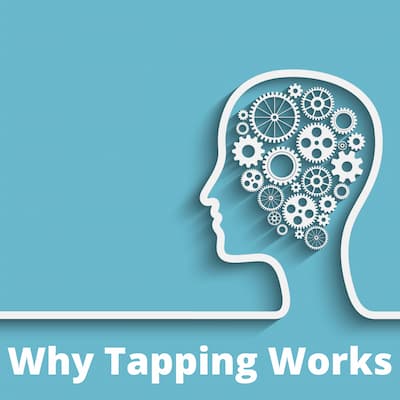 When acupoint tapping protocols were, in the 1980s, first formulated with a focus on psychological change, they were met with skepticism – even mockery – by the clinical community. But a lot has changed since then. Today, hundreds of clinical trials, peer-reviewed papers, and anecdotal reports show the positive – often rapid – transformational effects of energy psychology and tapping. Hidden within this growing literature are 6 fundamental evidence-based premises that demonstrate why tapping works and how it can be used as a remarkably powerful and effective technique in treating a myriad of challenging psychological and physiological issues.
  Feeling out of control is one of the hardest emotions to overcome. This is true whether we feel personally out of control or if our circumstances feel that way.
 As humans we are constantly changing and evolving.
 Relationships are challenging for everyone, yet the quality of your relationships correlates strongly with your happiness, sense of well-being, and even your physical health. Can acupoint tapping help you and your clients address the challenging issues that even the best relationships bring our way? Practitioners are, in fact, finding that the answer to that question is “Yes!” Tapping can be effectively applied to foster greater intimacy, trust, understanding, and ease.
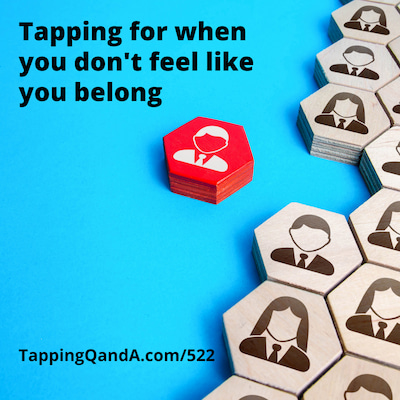 Sometimes we spend time with people whose lives are very different from our own.
 I wasn’t the coolest of kids when I was in middle school. I was on the math team. At the age of 13 my feet were larger than my 6′ 2″ tall father's, although I was only 5′ 7″ at the time. AND to complete the picture, I had a mullet.
 The most common question I receive from my readers and listeners is “What are the best phrases for [insert issue] when tapping?”