Did you know that there is a quick and easy way to create a tap-along audio to any EFT script you find on line? This is how you do it.

Did you know that there is a quick and easy way to create a tap-along audio to any EFT script you find on line? This is how you do it.
[In this series we examine the importance of the words we use and how changing our vocabulary can change our minds, giving us opportunities for transformation. More articles can be found in this series @ Tools: Words]

photo by SweetCakery |
In a recent episode of “Making It w/ Riki Lindhome” Riki and Pete Holmes were talking about the idea of entitlement. They were discussing the sense of entitlement that many young actors have when they first get to Hollywood. Many of them arrive in Los Angeles having been stars of their local theater scene. They think that by simply showing up they are entitled to success.
Riki made a distinction between “passive” and “active” entitlement. She stated that passive entitlement is when you show up to a situation and simply expect to get your way. For example, in a new job feeling like I should be able to work on the coolest projects.
On the other hand active entitlement is much more about what you are willing to work for. For example, who is to say that I am not capable of writing a best selling book? Writers of best sellers are not a preordained group of people who were destined for success. If I am willing to put in the work (i.e. by being active) then I, as much as anyone else, am entitled to create a best seller.
When we are in a state of passive entitlement we are not going to be able to move forward and are going to feel bitter that the universe is not giving us our just deserts. When we are in a state of active entitlement we recognize that we are capable of anything if we are willing to seize the opportunity.
To make sure that we are in a state of active entitlement we can tap on something like this:
I know that I am capable of being successful…I know that I have been made for success…but success and opportunity aren’t going to just show up at my front door…I need to seek success…I need to work for success…The universe owes me nothing more than the opportunity to work for what I am made to be…This does not mean that it must be a great struggle…This does not mean that I have to toil to achieve success…But I am entitled to success…I am entitled to opportunity…I have been made for this…I give myself permission to work actively towards the opportunities and success I am entitled to.
Action Step: What is something that you feel others are entitled too, but isn’t for you? Take a few moments to tap on it with the script above. Do it now! It will only take 90 seconds.
Learning EFT can be very exciting at first. Tapping is so easy.
Anyone can do it!
It can be done anywhere!
It seems to work for everything.
You download podcasts, tapping scripts, and ebooks. You start working on a personal peace procedure, listing every bad memory you have in your life. You decide you are going to tap for your health, your relationships, your creativity, and getting a better job.
And then…
It just becomes too much!
You feel overwhelmed with how much work you need to do, how far you want to go, and feeling like there is not enough time to deal with everything.
It’s going to ok!
Take a big deep breath and relax…you don’t have to do it all right now!
Healing is process, not a moment. You are not going to do it all at once. It is ok to let the process unfold over time. You want a long-term, lasting fix. You don’t want something that is quick, but does not last.
Here are 6 things to help prevent you from becoming overwhelmed with tapping and the amount of change you want to bring about in your life.
On an average day I spend about 7 minutes tapping. I start my day by making sure I am relaxed and calm about what is ahead. I know that on the surface it doesn’t seem like I am doing very much towards my healing process, but these 7 minutes make a huge difference.
When you start the day from a relaxed, balanced place it puts you into a state of mind where you can respond easily to the unexpected. Being able to respond more easily to the unexpected means less stress in your day. Less stress means less overreaction, and less overreaction means less stress.
When you release all the stress from your day before you go to bed you sleep better. When you sleep better you start the next day in a better place. When you start your day in a better place…well you know how it goes…see paragraph above.
I am not saying that you shouldn’t go after major issues. I am not saying that you shouldn’t tap for longer than 7 minutes. You really only need to do longer tapping sessions once or twice a week. If you combine doing daily stress management with a few longer sessions each week you will make lots of progress.
Looking for help on how to tap at the beginning and end of the day? Check out these tap along audios.
Sometimes it is hard to tap because we don’t know where to start. There is so much that we can’t find an entry point. When this happens give your mind a break and let someone else come up with the tapping phrases. Did you know that there are over 35 free tap along audios on this site? Well, now you do. Pick one, hit play, and let the audio do the hard work.
Recently I did an interesting interview with Steve Wells on Self Acceptance. Steve proposed that the root of all issues is that we don’t fully love and accept ourselves.
On some level, when we hear this, it might make us shudder. There is nothing about tapping that my clients complain about more than having to say “I love and accept myself …” as part of the set up phrase.
I don’t know if I fully agree with Steve, but I think one of the reasons that we struggle with saying the set up phrase is because we find loving and accepting ourselves difficult.
If you don’t enjoy saying the set up phrase or if you are looking for an easy, concise set of phrases to tap to visit the set up phrase generator. Each time you reload the page it will give you 10 unique tapping set up phrases. Tap through the list. After you have finished, just refresh the page and it will generate 10 more. Do that two or three more times. It takes less than 5 minutes, you will feel great and will not become overwhelmed with having to dive into lots of issues.
Many of the issues we have are intertwined. When we work on one part, we are working on the whole. It’s ok to give yourself permission to let the healing process unfold over time. It is very easy to feel like we are not doing enough each time we sit down to tap. If that is what you are dealing with then start your tapping session with this:
I give myself permission to know that it is a healing process…not a healing moment…I give myself permission to know that I don’t have to do it all today…I don’t have to clear it all in one session…I know that if I do a little work today it is going to get me closer to the health and freedom that I want…Each time I tap I am going to clear a little more…each session is going to build on the last…I don’t have to do it all right now…
One of my favorite tools is to tap for all your issues at once. It is a very simple technique that is often called the basket or container technique. Here is audio instruction for the Container Process.
Did you know you can tap without having to tap? It is possible to tap by just imagining you are tapping. It is also possible to find relief without having to tune into a specific issue. Once you learn it from this short audio you will be able to do it anytime, anywhere and it will only look like you are sitting quietly with your eyes closed. It’s so funky it doesn’t have a name, but you will love it! Listen to it now.
Are you having trouble coming up with tapping phrases? Here is a simple solution: think of an emotion that you would like to work on, such as anger, sadness, feeling overwhelmed etc., and answer the questions that follow. Once you have answered all of the questions, hit submit and *poof* there is a tapping script!
Name a negative emotion:
Describe in detail what happened in a situation where you felt this emotion:
Describe in detail how it affected you when it happened:
Describe in detail how it is effecting you now:
Describe in detail all of the negative outcomes of what happened when it happened:
Describe in detail all of the negative outcomes you are experiencing today from this situation:
Describe in detail how you feel about the outcomes:
Describe in detail all possible future negative outcomes from what happened:
Describe in detail how you feel about these possible future outcomes:
If you had the power to change anything about this situation describe in detail how you change it:
Stress is not becoming a part of our daily lives, it is already part of our daily lives. What is now common is that we moving from a general level of stress to feeling completely overwhelmed. The difficulty with feeling overwhelmed is that once we are in the middle of it we can’t see clearly enough to reach for a tool like EFT. In this interview with Carol Look we look at the simple things we can do daily to keep our stress in check and keep us from becoming overwhelmed.
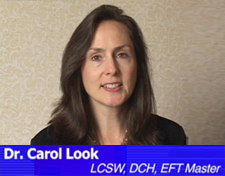 |
Guest: Dr. Carol Look
Contact: web @ CarolLook.com; twitter @CarolLookEFT
About Carol: A pioneer in the Energy Psychology field, Dr. Carol Look has brought unprecedented innovations to the application of Emotional Freedom Techniques (EFT), and has produced outstanding results for her clients around the world.