• Skip to primary navigation
  • Skip to main content
  • Skip to primary sidebar
  • Skip to footer
  • Leave A Tip

Tapping Q & A with Gene Monterastelli - Get the most out of tapping and EFT

  • Learn Tapping
  • Podcast
  • Video
  • About Gene
  • Work w/Gene
  • Archive
    • Every Post Ever
    • Q&A
    • Podcast
    • Videos
    • Tools
    • Tap Along
    • Sessions
  • Events
  • Contact Us

I don’t believe the words I say while doing EFT!

September 9, 2007 by Gene Monterastelli

I don’t believe some of the things I say when I tap. Does that matter?

For us to do work on any thought/emotion we need to bring it into our thought field (meaning we are feeling or thinking it) at the moment we are tapping. That might be a little bit of a confusing statement, so let’s think of it in terms of the analogy of washing dishes.

The only place we can wash our dirty dishes effectively is in the kitchen sink. We have dirty dishes all over the house. They can be by the TV from watching football last night, on the kitchen table from lunch today, and on the counter by the sink. We can know where all the dishes are, but until they get into the sink, we can’t wash them.

It doesn’t matter how those dishes get into the sink. It only matters that they get there. We can put them in the sink, or someone else can put them in the sink. Once they are in the sink we can start cleaning.

When we are doing Emotional Freedom Techniques (EFT) we have to do the same thing. We need to get the thought, the physical pain, or the emotion into the “sink” before we can clean it. We can know intellectually what our issues are, but we can’t do anything about them until they are in the “sink”. Our “sink” is our thought field, meaning once we are feeling the emotion it is in our thought field.

Let’s suppose the following. I know my boss treated me badly at work today, but until I play the memory back as a movie in my head and really start to feel my rage, I haven’t moved this memory into my thought field (”sink”). Once I have done this, I can start doing EFT to get relief.

With that as background it brings us to the question of what words work best. The words that we say are not magic. They are only important in that they help us get what we want to work on into our thought field (get the dishes into the sink). Just like getting the dishes to the sink, it doesn’t matter how they get there. All that matters is that they get there.

Let’s say I want to improve up my self-esteem when it comes to talking to the opposite sex. In order to do any work in this area I need to bring the feeling of discomfort talking to a woman into my thought field. I have two options for doing this.

First, I could go right at the issue and tap like this:

“I am such a moron.
I can’t talk to women,
I always sound like a fool.
They think I am so stupid.
They wish I would leave them alone, because I’m wasting their time.”

This is a very simple direct approach to the problem.

Or I could take a second tack. I can instead take advantage of the little voice in my head that tells me I’m not good enough. Please note what the voice in my head does.
“I am a funny guy.
[voice in head: No, you are not.]
I am a charming conversationalist and people love talking to me.
[VIH: No you’re not. You sound like a fool talking to others. You never know the right thing to say.]
I am going to walk up to someone new tonight and just start chatting.
[VIH: No, you are going to be a sweaty mess and chicken out.]”

[How to use these tapping phrases]

In this instance, I didn’t believe a single thing I said out loud, but the voice in my head brought up all the stuff that needed to be cleared.

Both approaches brought the dirty dishes to the sink. In the second case, by saying things I didn't believe the little voice in my head brought the emotions that needed to be cleaned up into the thought field.

For anther example of this approach, see I don't know what to say! (part 1)

Filed Under: Q&A Tagged With: Abundance, How To, Phrases

Doing It All Wrong

September 3, 2007 by Gene Monterastelli

I’m having trouble getting started with EFT. It’s almost like I have a fear that I will do it wrong. Any suggestions?

This questions was written in response to the article  Fear of fear, where I talked about clients who have a hard time starting because they are afraid of the emotions they may stir up by thinking about them in detail.

Along with fear of stirring up too many emotions, a very common worry about doing Emotional Freedom Techniques (EFT) is the fear of doing wrong. I hear this often from my clients.

At the end of every session I give my clients homework. This enables them to make progress until our next session. One of the reasons

I love EFT is it empowers the client to do self care. They don’t have to be dependent on a practitioner to make progress.

To begin the next session, I check to see how much homework they did. Often, when they haven’t done much work on their own, it’s because they’re worried they can’t do it right.

When I am confronted with this circumstance I do two things.

First, I explain there are no known side-effects to doing EFT . It only takes 10 minutes to try. The worst thing that can happen is you waste a little time. If you do EFT in a private place no one will ever know you didn’t do it well.

All of this is true, but I know that even when I have the facts before me, if there is an emotional root explaining why it still might not work out, I won’t try.

Therefore, the second thing I do is ask why they are worried about doing it wrong. Some common responses are:

  • If it doesn’t work, it means EFT isn’t real, and I’m afraid to give up hope of getting over the things I’m struggling with
  • You do it so easily; I’m afraid to fail at something that is so simple
  • If it doesn’t work now, it means all the progress we’ve already made isn’t real
  • It’s been a long time since I learned something new, and I don’t like the feeling of uncertainty.
  • I don’t understand why it works, so there is no way I can do it right
  • If I get better, how am I going to explain the progress to my loved ones? They will think I lost my mind when I tell them it was from tapping.

So what we do is tap on these issues of worry. I encourage all my clients who struggle just to get started to begin each session they do on their with something like this until they are more comfortable

I’m having a hard time tapping on my own…I don’t know if it really works…I have failed when I tried in the past…I don’t know if I am going to do it right…Gene makes it seem so easy…But, I don’t know what to say. It is really hard to come up with all those words…It has been so long since I have tried something new. I don’t like feeling like a novice…But I understand the only way I can get better is if I try…There is nothing in my life I learned to do perfectly on the first try. …Today I take driving for granted, but it took time to learn…I walk without even thinking about it, and that took months to learn…I give myself permission to be okay with not being very good at this…Each time I do EFT I will do better…I know there are people out there who have experience, and I can ask them for help…They were novices at one point too…For the next 30 minutes I give myself permission to be really bad at this…I give myself permission to make lots of mistakes…Because I know it is in the mistakes that I am going to learn and get better…And because I can’t hurt myself by trying…Assuming I don’t poke out my own eye…The only thing I might do is waste 30 minutes…There are lots of times in my life where I have wasted 30 minutes on a TV program…I can try this for 30 minutes…I know it is best for me just to give it a try…I am doing this work in private, so no one will know I’m doing this…If I do it wrong, no one will know I didn’t do it right…I know there is a possibility that EFT might not work on this issue this time…But that doesn’t mean EFT doesn’t work…It doesn’t mean that EFT doesn’t work for me…It only means that it is not working for me this time…EFT has worked in the past for lots of people…EFT will continue to work…If it doesn’t work now for me I have learned what not to do…I have an experience I can explain to someone who is more experienced…This feedback will help them to help me…I know there are lots of people I can ask for help…That’s one of the great things about people who do EFT — they want to help others…If all else fails, I can email EFT Q & A for help…I am not alone in doing this…And I am allowed to try again and again with EFT. [How to use these tapping phrases]

One final note: Yes, it is ironic that people who are afraid to tap on their own are willing to tap on not being able to tap. I wish I could explain it. I just know people are willing to try, and it works.

Filed Under: Q&A Tagged With: Fear, How To, Phrases

Moron!

August 30, 2007 by Gene Monterastelli

My boss is a moron. He makes my life miserable. I’ve tapped on the issue, but it’s not getting any better. What can I do?


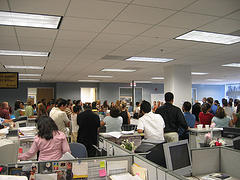
photo by redteam

Before we decide how to deal with this problem, I need to explain how to use truth phrases.

I’m a big fan of using truth phrases when working with emotional issues. With truth phrases we rate how true we think a phrase is. These phrases differ from the standard rating of intensity.

For example, with the phrase, “How angry do you feel?” we are rating the intensity of the anger. With the phrase, “I get angry when my partner doesn’t listen to me,” we are rating how true this statement sounds, 10 being completely true and 0 not being true at all.

At first, rating how true a phrase is can be a little tricky. Just remember how odd it felt to rate anger on a scale of 0 to 10. There is a reason we call the scale “SUBJECTIVE” units of distress. It’s just a benchmark to see if progress has been made. It’s more an art than a science.

Truth phrases can be very helpful because they incorporate what we feel (anger) and why we feel it (because my partner doesn’t listen). When we know what the emotion is and why it’s there, we are more likely to be tuned into the core issue of the emotion. The closer we are to the core, the more effective our work is going to be.

Examples of truth phrases are:

When I’m worried I eat to soothe myself.

I feel unvalued when my voice isn’t heard.

I’m worried because I don’t think I’ve done enough work for tomorrow’s meeting.

I’m sad my family doesn’t care about the work I do.

I’m angry that our government is so corrupt.

For truth phrases to be effective we need to have both parts of the phrase. We need to state what emotion we feel and what the causes of the emotion are.

Note: Many times we have no control over what is happening around us. Whether people refuse to hear us, whether they don’t care about our work or that our government is corrupt, we may just have to live with these facts. It would be great to believe that someday our family is going to be as passionate about our work as we are, but we have no control over the emotions of others. Usually all we can change is our emotional response to these states of the world.

A common mistake with truth statements is that we forget to add our emotional response, tapping only on the state of the world.
For example, the statement “My boss is a moron!” might rate as a 10, but no matter how much tapping we do, our boss is not going to get any smarter. This phrase is not properly structured because it’s missing the emotional response.

A more useful phrase is, “I’m very frustrated because my boss is a moron.” When this rates as a 10, we can then investigate why this is frustrating. (e.g., it creates more work. We look bad to the rest of the company. I have to do his tasks over after he messed them up).

As we tap and make progress on the reasons that cause frustration, we can come back to retest “I’m very frustrated because my boss is a moron.” Once this statement no longer feels true, we know we’ve done what we can. Our boss is still a moron, but this is no longer emotionally controlling our lives.

Filed Under: Q&A Tagged With: How To, Physical Response

Cleaning House

August 28, 2007 by Gene Monterastelli

I’m having a hard time cleaning my office. Can I use EFT to help from being distracted and just get the job done?


photo by Jaymie

Recently one of my clients, “Julie,” was about to start packing up her office. She had quit her job as she was moving on to do work that she really loved. I offered the following suggestion. “Before you clean your office, sit in the middle of the mess and tune in to it. See if it has anything to say about how you feel about the transition you are going to make. If any emotions arise from this, simply pay attention to them. Do Emotional Freedom Techniques (EFT) on any undesirable emotions before you start to clean the office.” Often the emotions we feel tell us something about how we fit in that situation. When we make necessary changes in ourselves first, the other tasks, even cleaning and organizing, are much easier.

Here is what she later wrote about the experience on her blog:

“Yesterday I received some wisdom from a friend regarding the only item on my to-do list this week…cleaning and packing my office. His advice was to tune myself in to the mess, let it speak to me, let any emotions related to the mess come to the surface and pay attention to them, acknowledge them, and then clean them.

“Having said that, I completely disregarded his advice when I got to the office this morning because I had done an amazing job on the drive in convincing myself that the state of my office is clearly about a lack of shelf space and couldn’t possibly be emotional, a reflection of myself, etcetera, on any level.

“Forty minutes into my cleaning and packing project all I had done was rearrange piles. Not one paper clip was packed. Not one piece of paper tossed in the recycle bin. I plunked myself onto my leather sofa, took a few deep breaths, and started to tune myself in to the space around me. And it began to speak. My bookshelf told me one thing. My desk told me another. The enormous box of Christmas lights whispered that I am really afraid that by choosing to leave my current job I am going to be left with a giant void of laughter in my life if I don’t spend time with teenagers on a regular basis. Who knew Christmas lights were so insightful? The wall in front of my desk covered in pictures, quotes, and notes, spoke very clearly about the struggle of managing long distance relationships. Little by little I was able to acknowledge and clean the feelings around cleaning my office…and as a result I made a serious dent in packing things up. By the time I got to the stack of paintings leaning against the wall, my perspective had completely shifted. (Sometimes we don’t want to hear what things, situations, or relationships have to say.) But now I was ready, even eager to keep moving forward. I will admit that I was tempted to take the artwork and spread it out around the room but I had at some point chosen to stack them in a pile way back when and needed to pay attention to that.

“So I did.

“And this is what was revealed…

“Don’t be afraid. You are an artist in bloom.”

Now, did the mess, the desk, the walls, or the paintings really talk? They talked no more or less then when I ask my clients, “If the pain in your knee could say something, what would it say right now to you?”

Did the information come from outside or within? In my mind it doesn’t matter, but by tuning in and listening Julie was able to identify emotions she was feeling about her transition. Before they were under the surface. They were hiding (or she was just refusing to hear them). By tuning in a different way — admittedly a very different way– she dealt with feelings that needed to be healed before she could move on.

From time to time I suggest this to my clients. The process is very.

  1. Sit in a place where you spend a great deal of time (office, kitchen, bedroom, or car).
  2. Tune into the area around you.
  3. Ask if the car/desk/table/wall could say something, what would it say?
  4. If something arises, do EFT on what you were tuning into, but whatever emotion has just grown in yourself.

Filed Under: Q&A Tagged With: Home, How To, Work

I Can’t Focus

August 17, 2007 by Gene Monterastelli

There just aren’t enough hours in the day. I know setting time aside to tap is important, but I have trouble focusing on my tapping. When I sit down to tap I have a million thoughts running through my head. What can I do to focus on the task at hand?


photo by Eni Turkeshi

This is a common problem. We know we need to take care of ourselves, and we think we have the time to do it. But somehow our responsibilities expand to absorb our whole day.

Despite busy days, we HAVE to find time to take of ourselves. When we don’t take care of ourselves we become less effective, which puts us even farther behind.

I encourage all my clients to take some time, to focus before they start tapping. I know when I do this I’m less distracted, more focused on the task at hand, and I.m more likely to spend enough time tapping.

Usually I recommend they address a few areas before tapping:

1) Dealing with any resistance to believing EFT works

EFT seems so weird…How is it possible that tapping on my face and body is going to help me emotionally…If my friends saw me now, they would think I’ve lost my mind…But tapping has worked in the past…It does make me feel better…And it only takes a few minutes of time…Even if the tapping has nothing to do with it, I feel better for taking the time to care for myself

2) Dealing with a cluttered over-busy mind

I have a million thoughts running through my head…I have so many things to do…My thought are running a million thoughts a second…But I choose to know that I can focus my mind…I know that I can slow the thoughts down…I give myself permission to let all those thought go…I know that as my mind slows down I will relax…I don’t need all those thoughts right now…I am focused here

3) Dealing with feelings of guilt for not doing the tasks that are at hand

I have so much to get done…I’m so far behind…Every time I catch up some new problem erupts…I don’t have time to do this tapping…I should be working on my to-do list…I should be making dinner, cleaning the house, getting work done, working out…But I choose to know that I need to take care of myself…I know that if I don’t take care of my self I will get sick and won’t be able to get done what I need to get done…I give myself permission to take time for myself…I deserve to take some time for myself…I know that when I take care of myself I am a happier, more efficient person

You can do each of these by themselves or you can just run through all three without stopping. The goal of this tapping is to get your self into the mindset that will allow you to take the time you need to tap, guilt-free.

If after doing all these phrases you are still unsettled and not focused, just tap through the phases again.

Filed Under: Q&A Tagged With: How To, Phrases

  • « Go to Previous Page
  • Page 1
  • Interim pages omitted …
  • Page 42
  • Page 43
  • Page 44
  • Page 45
  • Page 46
  • Go to Next Page »

10 Steps To Stop Self-Sabotage

Get your FREE 10 step guide to using EFT to stop self-sabotage in your life.

Search Tapping Q & A

Meet Gene Monterastelli

Gene MonterastelliGene Monterastelli is a Brooklyn based tapping practitioner. In addition to working with individual clients and groups, he regularly writes and records about how to use tapping to move from self-sabotage to productive action.
Gene’s Full Bio & Services


Subscribe via: Apple Podcasts | Google Podcast | Android Phone | Spotify | Pandora | Amazon Music | Audible | iHeart Radio | Castbox | Alexa | Stitcher | TuneIn | Deezer | aCast | Himalaya | Overcast | Luminary | RSS
Visit the complete Podcast Archive

Apple App | Google/Android App


This book is not just about EFT and tapping for anger. The book contains some of the most comprehensive step-by-step tapping tools that can be used for all emotions and can be added to your tapping tool set right away.

For every book purchased, four inmates will also receive a copy of the book.

For every book purchased 4 inmates will also receive a copy of the book.

Paperback | Kindle Version

Copyright © 2026 · Refund Policy · Terms of Use· Privacy Policy