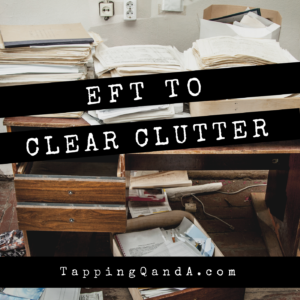
When my space is cluttered I find it difficult to work efficiently and the mess becomes an emotional and energetic drag on my day.
Recently I replaced my kitchen table with one that fits the space much better than its predecessor and took the opportunity to organize the piles of clutter that had made it their home. My tiny NYC apartment feels much more open and comfortable because that space is cleared.
Sometimes dealing with clutter is about more than setting aside the time to clean up. If you are having a hard time decluttering your space, it’s likely that there is an emotional component at play preventing you from taking action.
In this week's podcast I have for you my favorite technique for clearing out clutter and a tap-along to help you get started.
I recognize the fact that there is a huge amount of clutter that I need to deal with…It feels so overwhelming…It feels like it's never going to get done…Who knows what I'm going to find in those piles…I might be worried about what I'm going to discover…I also recognize the fact it feels like it is too much work…It is never actually going to get done…I am going to find myself stuck in the middle of this mess forever…I recognize the fact that if I take this a little at a time…If I clean this up bit by bit…Those small steps will make a huge difference…Every little bit of cleaning I do will move me closer to having this completed…Every bit of cleaning I do creates more space…It creates more movement…It makes my space more comfortable…Even if I only do some of this…It will make a difference in the long run…I give myself permission to allow that to happen…To see this as a gentle process…As I remove each little bit knowing I will feel better…I don't have to do this all at once…If I do this a little at a time I will be done sooner than I could imagine.

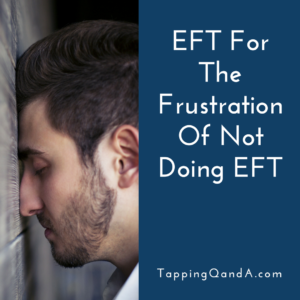 For me, knowing what to do and not doing it is more frustrating than not knowing what to do.
 Our bodies are far from perfect.
 Last week I shared with you a simple process for
  Good morning,
 As the year draws to a close it is good for us to reflect on the last twelve months. This week I have for you a process that will lead you through a simple reflection of your year.
 My friend Catherine Poole uses the term “weight release” instead of “weight loss”. I prefer “weight release” because I think it speaks to a more holistic approach to improving health than just diet and exercise.
  On some level we know that getting a good night’s sleep is important. I know the quality of my sleep impacts how I handle each day. But did you know:
 Over the years I have collected many of my favorite tapping phrases and ideas to help to maintain a healthy body.
 I have found in my own life that one of the most powerful emotions is gratitude. When we feel a sense of gratitude, even during trying times, it moves us to a disposition of possibility.
 Note: This week's topic is so important that I have written an article and recorded a podcast. The article shares the same ideas, but is not a transcript of the podcast. This way you can choose the form that works best for you. The tapping script is identical in both the article and podcast.
 Guest:Julie Schiffman
 Anything that is new and different takes time to be accepted into the mainstream. EFT is no different.
 There is so much of the world that we do not control. We are surrounded by people, just like us, who are making choices and exercising their free will.