• Skip to primary navigation
  • Skip to main content
  • Skip to primary sidebar
  • Skip to footer
  • Leave A Tip

Tapping Q & A with Gene Monterastelli - Get the most out of tapping and EFT

  • Learn Tapping
  • Podcast
  • Video
  • About Gene
  • Work w/Gene
  • Archive
    • Every Post Ever
    • Q&A
    • Podcast
    • Videos
    • Tools
    • Tap Along
    • Sessions
  • Events
  • Contact Us

Round Up Question 1 – What lessons have clients taught you about healing?

June 12, 2020 by Gene Monterastelli

One of my favorite aspects of the tapping community is how willing people are to share their wisdom and experience. Recently I asked a number of practitioners I admire about how they approach healing, client work, and their own journey. Below are some of my favorite answers to one of those questions. Make sure you check out all five questions

What lessons have clients taught you about healing

If I just hold the space from the deepest part of myself, present to my depth, my darkness, my pain, my light, all of it unconditionally, HEALING HAPPENS AUTOMATICALLY through them. I'm not “doing” anything but allowing it. Kim D'Eramo, D.O.

I always say my clients are the experts and I am the educated guide. I learn where to go and where not to go. I am always respectful that my thoughts are different from my clients' thoughts. If I ask what bothers them about work, I think they will say their boss or co-workers. I am surprised when they say the commute. So, I have learned to keep asking questions, keep exploring and being a detective to understand what this situation and emotion is for them. Robin Bilazarian, LCSW

I've learned that self-judgment of our uncomfortable emotions prevents them from processing naturally like they are designed to do. This is the brilliance of the EFT setup statement. We start with simply stating the truth. Of course, it's not always that simple because we aren't often honest with ourselves – or it's not conscious – about what we are feeling and why. We get to tap on that confusion, the ruses, the excuses, and the truth then presents itself. As soon as we clear the judgment, shame, lack of acceptance of and resistance to pain, the rest of the clearing often happens quite organically. It's always been easier to see this self-judgment in my clients than myself. It's led me to take my own advice and that has made a tremendous difference for me. Kris Ferraro

I learned that no matter how much I know or how much I want to give and support someone in their healing journey, they will receive only up to the point that they are ready to receive. Thus, whatever I have to offer, I give it with all my heart and allow the person to receive what he/she can receive. It will be perfect. Deborah D Miller

I have learned four lessons. People are much stronger than they seem. Motivation is key to healing. People aren't as self-aware as they might believe. Clients notice what's happening in the heart of the therapist more than it might seem, so authenticity is key. Jake Khym

I have learned to respect their healing path and to respond with patience. I've learned to set my agenda aside and keep meeting them where they are each time. When I do this, we make progress–not on my timetable but on theirs. Ange Finn

What I’m learning from clients now is that psychological and emotional safety is the number one condition for healing. That psychological/emotional safety is a much more ‘slippery’ deal than we realize. With the majority of clients they will say that they are experiencing safety, however that is a ‘conditioned safety’ or what I’m calling a ‘pseudo safety’ which has more in common with a nervous system chronically conditioned to a freeze response rather than a true embodied sense of safety. This makes the EFT conversation around psychological reversal enormously important. As well the conversation around the pace of the work with clients. Nancy Forester

Healing is possible even when they are and I am convinced it isn't. There is a deeper part of us that is always working to make us whole and when we can engage with it. Healing isn't just possible, it is inevitable. Steve Wells

I am always in awe of what /people are willing to do to become more of who they really are. Clients are willing to take the leap with someone they barely know and then share their deepest fears and trust that they will be safe. Mary Ayers

Especially when using Emotional Freedom Techniques, I have learned that the real issue isn’t always what the conscious mind thinks it is. A client will often present themselves in my office and tell me all about “their issue” only to later discover that it's really something quite different than what they thought. I have come to realize that the conscious mind often has little idea of what’s going on within the subconscious mind, which is where the actual issues reside.
Ted Robinson

Over the years I have had a few clients that completed the healing process only after I suggested they acknowledge that I am not their “healer”. They had gotten to a plateau and only after we worked on their ability to recognize that it was their own bodies that were doing the healing did they finish the process. The part of EFT that is so empowering is that much can be done on one’s own. Alina Frank

I have learnt that rapport is key. When a client feels accepted and connected for who they are, great healing occurs. Tania A Prince

Sometimes you need the courage to cry. I had been working with a client who had suffered emotional abuse from an OCD parent through all their schooling years. Every day they would put on a brave face to cope with school and the scorn and judgment of teachers and students.
After a number of tapping sessions, the control required to get through each day was slipping but the old habit of holding on to the mask was still strong. Eventually, as we tapped on the fear of letting go and the courage it had taken to survive all those years the release of tension and shame resulted in a much-needed release of tears and stress from their whole body. It takes great courage to let go and cry and we can help ourselves and others to find the courage required to do so within themselves.
Rod Sherwin
Filed Under: Q&A Tagged With: Alina Frank, Ange Finn, Deborah Miller, Jake Khym, Kim D’Eramo, Kris Ferraro, Mary Ayres, Nancy Forester, Rob Sherwin, Robin Bilazarian, Round Up, Round Up 2020, Steve Wells, Tania A Prince, Ted Robinson

Overcome The Three Biggest Obstacles To Tapping Success

April 19, 2017 by Gene Monterastelli

When people first sign up for my mailing list I send them an email asking them for the two biggest obstacles they encounter when tapping for their issues.

Far and away the three most common responses are:

  1. Not taking the time to tap even when you know you should.
  2. Not knowing what to say when tapping.
  3. Not knowing where to start with a particular issue.

In many ways I think the second and third responses are the reasons for the first. If you don't know what to say or where to start, you will avoid tapping. Nobody likes to feel incompetent.

In the end, it feels safer subconsciously and emotionally not to try than to deal with feeling inadequate.

I know I behave in this way from time to time.

There is a simple solution, but first a little story…

It was a great big experiment
Back in January I had this wild idea of offering just a few people the opportunity to tap with me for 15 minutes once week for an entire year. When I made the offer I mainly felt confident that it would work, but at the same time I was a little nervous.

First, I was nervous because I had never made an offer like this before and I didn't know how my audience would respond. Second, I had never worked clients in that way before. I was confident in my ability and confident in the power of tapping regularly, but I didn't know how the format it would work out for clients.

It was an experiment.

AND it turned out even better than I planned. I absolutely love these client calls! It is so much fun to work with a client over a long period and have the chance to help them exactly where they are each week.

What the participants are saying
It's one thing for me to feel like the process has been a success, it is something else to hear from the people with whom I have been tapping. Last week I sent each of the participants a note asking if they would be willing to share their experience.

Here is what a few of them had to say:

“With the combination of tapping, Gene's insights, and the recordings to use forever after, SO much is accomplished in just 15 minutes! I'm very grateful — and a little amazed — by the richness of these short sessions.”

“When I saw Gene’s offer for weekly 15-minute tapping sessions, I jumped at the chance. I appreciate the brevity of the appointments, the ease of scheduling sessions online, getting reminders via email, and that Gene calls me and I don’t have to do anything but answer my phone. I would probably not find time to tap without these quick weekly sessions. Gene has a gift for finding exactly the right thing to tap about in a thoughtful and non-judgmental way.” — Catherine

“Tapping with Gene has been one of the most effective forms of personal development work I have experienced. Gene has the unique gift for grasping the topic I want to work on with minimal explanations and instantly finds the right words to help uncover core issues. Additionally his sense of humor makes working with him as pleasurable as it is rewarding.”

“Here’s what you need to know – 1) It’s definitely worthwhile and amazing value for money, and 2) 15 minutes is definitely long enough for a highly impactful session! Furthermore, Gene records the sessions which means I can go back to them at any time and draw on what we did together on that day. I now have new resources I didn’t have before that are helping me each day to cope in a world where we’re all way too busy and believe that perfection is the standard.” — Caren Hendrie

“This is the most helpful thing that I am doing right now for my business and for my personal healing. Gene is a first-class coach who focuses just on my needs and the weekly sessions allow me just the right amount of time to digest what we discuss and to have my questions ready for the next session. Feeling totally supported in this way means I can take bolder steps. Things are really shifting.” — Dan

Why work with a practitioner?
One of reasons that tapping with another person can feel so much more powerful than tapping alone is because it solves the three problems listed above. First, you show up to tap because you have made the commitment, second, they provide the words for you, and third (when they are a skilled practitioner) they help you quickly to get to the root cause of what is going on.

Clients have told me countless times, “I had no idea that was the real issue. Thanks for helping me to find it!”.

Room for 6 more people
It’s been a lot of fun doing this type of work and I have seen how powerful these regular sessions have been for my clients, so I have decided to open up the offer to six more people in a slightly modified way.

You can have someone to help you to tap every week for the next six months for only $997. That price represents a 30% discount off my normal hourly rate.

There are only six spots. Once they are filled, that’s it. In order to be fully present to each of my clients I have to limit how many new people I can take on.

Read all of the details below carefully before you sign up. If you have any questions all you need to do is reply to this email.

  • You will receive a 15-minute session once a week for six months (26 weeks).
  • You are allowed to skip two weeks and have them added to the end of the six months.
  • You may not combine weeks to create longer sessions.
  • I am available for sessions 7:00 am to 5:30 pm Eastern time Tuesday, Thursday, and Friday. My regular office hours are between 10:00 am and 5:30 pm. I have added the extra morning hours just for this program.
  • Because of travel I am not always available every single Tuesday, Thursday, and Friday, but will always be available at least two of these days a week.
  • It is the client's responsibility to schedule their sessions on my online calendar.
  • The purchase is non-refundable.
  • Every effort will be made to record the sessions so that you can go back and tap along to the audio again in the future, but there is no guarantee the session will be recorded. I make every effort to make this happen, but very occasionally technical issues that corrupt the audio get in the way.

I know. All of those details seem kind of heavy and not in the spirit of healing. I wrote those bullet points in blunt terms to make sure that we are all on the same page.

Like I said, there are only six spots.

If you would like to sign up, you can do so here: https://tappingqanda.com/6months

Filed Under: Q&A

10-Part Weight Release Series with EFT

December 26, 2016 by Gene Monterastelli

My friend Catherine Poole uses the term “weight release” instead of “weight loss”. I prefer “weight release” because I think it speaks to a more holistic approach to improving health than just diet and exercise.
It is about allowing our system to let go of the weight that we are holding on to for both physical and emotional reasons.

Here is a 10-part guide to using EFT and tapping for weight release.

Part 1: Making it safe and giving ourselves permission to heal

Part 2: How to respond when our weight release goals don't feel emotionally believable

Part 3: The connections between weight and emotion – an interview with Catherine Poole

Part 4: Dealing with mindless eating

Part 5: Pre-emptive tapping to avoid temptation

Part 6: Our relationship to food

Part 7: Our relationships to others when we are around food

Part 8: Why we don't tap even when we know it works

Part 9: The emotional reason for extra weight

Part 10: Tapping to improve metabolic function

Filed Under: Q&A Tagged With: Catherine Poole, Weight Loss, Weight Release

Do I Have To Say The Phrases Out Loud When I Use EFT?

September 19, 2016 by Gene Monterastelli

In Podcast #236 I answered four listener questions. Below you will find the audio of all four questions and the transcript for question #4. Please bear in mind that I speak in a slightly more informal fashion than I write, which you will notice in the transcript below. The transcript has been edited slightly for clarity. If you have a question you would like answered in a future podcast please let me know.

Do I Have To Say The Phrases Out When Tapping-Question: I would like to know whether it is best to talk out loud when you're tapping or if it's okay to just focus on the issue, memory, or body sensation without using words? I wonder if whether using words silently or out loud engages a specific part of the brain and whether or not this has a different effect?
Jane in France

This question shows up in lots of ways. Sometimes I would get emails that ask me, “What are the tapping phrases for in certain issues?” As if there are some sort of specific magical phrases for tapping.

We know for tapping to be successful, it's a combination of two things:

  1. We are tuning in concentrating on the issue, and
  2. We are providing stimulus to the tapping points.

That's where the relief comes from.

The way that we tune in can be different from moment to moment, from person to person. It is possible for me to say words out loud and not have it be a focusing factor. I can say, “this pain in my knee, this pain in my knee, this pain in my knee” and be completely preoccupied with my laundry or the errands I have to run. It doesn't matter that I'm saying the words out loud.

There are other times where I can be completely focused and engrossed in my knee and not say any words at all, just in the way that I put my attention.

For me, what I think most important is to create concrete details about what we are tapping on. For us to have concrete details we need to give the issue language. As an example, I want you to think about an apple.

As you did that you might have thought of a computer or you might have thought of an apple, like a piece of fruit. What I want you to do is to focus on a piece of fruit if you thought of a computer.

I want you to describe the apple. What does it look like? Does it have a stem? Does it have a leaf? What color is it? Is it red, is it green, is there yellow because it's still ripening? Is it firm? Is it kind of mushy?

As you tune into it you start to give it specific characteristics as it comes into sharper focus. When we're tapping, the sharper focus we can bring something in, the more successful the tapping is going to be.

That doesn't mean we have to have it in sharp focus. It simply means anytime we can get the focus sharper it will allow us to move forward.

There are times when I am tapping with a client and they are just bawling hysterically so I really don't need to ask them, “Zero to ten, how big is your sadness? Where do you feel it in your body?” That's not the question I need to ask. It is something that is so consuming and they are so tuned into it in this moment, we just have to tap.

When this happens what we'll notice is as they tap and the intensity comes down, all of a sudden they will start to having language for it. It's heaviness in my chest, it's a burden on my shoulders, it's tears stuck behind my eyes. As the intensity comes down, the clarity becomes useful because it's becoming smaller and smaller and it's not our entire experience.

For me it doesn't matter if I say the words out loud or I think them internally, what's important is how specific I'm getting.

For example, if I'm tapping on a pain I'll ask myself these questions:

  • What is the shape of the pain?
  • Does it have an epicenter or is it evenly distributed?
  • Is it sharp, dull, hot, poky, burning?
  • If I were going to paint a picture of this pain what colors would I paint it?
  • Is there an epicenter?
  • If I pulled it out of my leg and I held it in my hand, how much would the pain weigh?
  • If I was going to make a model of this pain so I can show it to second grade class, what materials would I use to demonstrate what it feels like?

None of those questions are diagnostic. It's just about me focusing in and being really clear about what's going on. I find that if I'm writing something down on a piece of paper or if I'm saying it out loud, I won’t take shortcuts. I'm going to be specific about what I am saying.

When I teach classes even if people aren't taking notes and they're recording it, I have them pretend they're taking notes and not just by moving their hand like they're writing, but actually have them make the letters of the notes they would be writing down. Because by forcing ourselves to give words to an experience we're making it more concrete, and the more concrete we are, the more successful the tapping will be. For me it's less of an issue of out loud or not. That's not what the issue is, the issue is whether or not I'm being specific with the words that I'm saying, and as I'm specific with the words it allows me to release and create transformation.

Filed Under: Q&A Tagged With: Out Loud, Outcome, Phrases

What To Do When The SUD Scale Doesn’t Work For You

September 12, 2016 by Gene Monterastelli

In Podcast #236 I answered four listener questions. Below you will find the audio of all four questions and the transcript for question #3. Please bear in mind that I speak in a slightly more informal fashion than I write, which you will notice in the transcript below. The transcript has been edited slightly for clarity. If you have a question you would like answered in a future podcast please let me know.

what-to-do-with-sudQuestion: For people who don't like numbers and tend to measure intensity in very subjective terms, how do you guide them to more meaningful/useful measurements?
Meg, Maryland

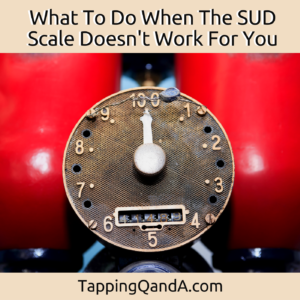
When he came up with EFT Gary Craig used the measurement called a SUDs level, which stands for “subjective unit of distress”. What is really interesting in this question is it feels as if when we're using numbers we're giving something that's concrete because it's measurable and it's a number. But the truth of the matter is that even when we are putting a number on something, it's still subjective.

From the very beginning recognize the fact that it's not about getting something to a three from a seven and bringing it down, it's more about creating progress and way of measuring that progress.

Often times when work with children for whom assigning a numerical value to something is meaningless because they don't have a conceptual sense of numeracy, other than knowing their age just because they've been told it. So instead will have kids use hand gestures, kind of like they're showing me the size of the fish.

How big is your anger right now? Or, how big is the nervousness in your stomach? Show me with your hands how big it is. And they really like that.

Again, it's subjective and it's giving us this measurement. The thing that's most important about using any sort of measurement is to give us feedback about the tapping we're doing to see if we're heading in the right direction.

There are three types of responses that we can have to tapping.

The first type of response is we feel better. I'm thinking about an issue. I'm thinking about a worry. I am not as worried and the number goes down. Or my anger goes down from a seven to a four. There's less anger and the intensity of that emotion decreases from a seven to a four.

The second type of response is there's absolutely no change at all. We do a round of tapping, it's still in the exact same spot.

The third type of response that we can have is it can actually get worse, or it feels like it is getting worse. For example the first time I tuned into this pain in my knee it was a seven but now that I've tapped on a couple of rounds, it's now a nine.

Let's take those three responses and just see what they mean.

The first response, it gets better. Well, that's what's happening, it’s getting better and that means we're on the right path. Once it has gotten better we now ask ourselves the question, do I have enough relief or do I want more relief to what is going on? Because sometimes the goal isn't to get the issue to a zero.

For example, when I'm at a holiday party and I see the sweets over there and I'm really craving sweets, I don't have to eliminate the craving. I simply have to reduce the craving enough so that I am not tempted to eat the treat that I don't want to eat, and instead I make a good sensible eating choice based on what I consciously want to do in that moment. I just want better, I don't necessarily need it to go away. We evaluate, has it gotten better? Has it gotten better enough that I can make a good choice? If not then we tap again to clear as much as we need to.

The second response is it stays exactly the same. If it stays exactly the same, that means is we're either not tapping on the right issue, there is a reversal of some sort, or we need to get more specific. If this is the case we need to change our tactic so we can approach it in a different way. When we change our tactic and approach it in a different way, we put ourselves in a position where we can be more successful.

The third response is it gets worse, the pain actually intensifies, the anger intensifies, the craving intensifies, and as odd as it seems, that's actually a really good thing. Not that it's more painful, not that it's more intense, but it's a really good thing because it means that we're on the right path. Think of it this way. Your knee aches, you have had a knee problem for years and years. As you move through the day you don't notice it but when you get home from work, you sit down on the couch, take off your shoes, lean back, and then all of a sudden your knee starts to throb.

The sitting on the couch did not cause your knee to hurt more but instead because you've been dealing with the business of the day you've been thinking about all the things that are in front of you, and so you tune out the pain in your knee in the exact same way you're tuning out the pressure your socks are putting on your feet right now. The instant I said “socks on your feet” you felt your feet. Even if you weren't wearing socks you feel your feet touching the floor. You brought attention to it. Your socks didn't magically cling to your feet in that moment, you just gave them your attention.

There are times when we're tapping when the intensity goes up because we're just focusing on the issue that was already there and we're shedding light on it so it feels bigger. In this process of tapping we're just looking for feedback. I do a round of tapping I ask is it something that I think is better, is it worse, is it staying the same? That will dictate what my next step is. Either I'm done, or I need to tap more, or I need to approach it in a new way.

When I'm dealing with a client who is really struggling with assigning numbers to the questions like “how big is it?” they might say, “I have no idea how to judge how big grief is, it's just overwhelming”. We do some rounds of tapping, after we're done I say, “I want you to imagine what grief felt like when it was overwhelming, what's it like now? Is it still overwhelming or is it something else?”

You'll notice in the question I'm not asking, is it more, is it less, I'm just asking if it's different. If it's different I will focus in on that difference, “It's different how? Tell me how it's different?” If there's still something that's hanging around we're just going to tap on the new thing as if it's the only issue in the world and it's the first thing we've been presented.

We simply know we're heading in the right direction because it's changed in some capacity.

We create this graph to show exactly how much smaller the problem is. We're simply saying, okay, compared to what it was before, how is it now? Are you satisfied with that or do you still want change? I have found if you approach it in that way it will put you in a circumstance that will allow you to be more successful in communicating the transformational process because sometimes transformation isn't as easy as “If it was a seven and it's now a five”.

Filed Under: Q&A Tagged With: How To, Measure, Success, SUDs

  • « Go to Previous Page
  • Page 1
  • Interim pages omitted …
  • Page 5
  • Page 6
  • Page 7
  • Page 8
  • Page 9
  • Interim pages omitted …
  • Page 46
  • Go to Next Page »

10 Steps To Stop Self-Sabotage

Get your FREE 10 step guide to using EFT to stop self-sabotage in your life.

Search Tapping Q & A

Meet Gene Monterastelli

Gene MonterastelliGene Monterastelli is a Brooklyn based tapping practitioner. In addition to working with individual clients and groups, he regularly writes and records about how to use tapping to move from self-sabotage to productive action.
Gene’s Full Bio & Services


Subscribe via: Apple Podcasts | Google Podcast | Android Phone | Spotify | Pandora | Amazon Music | Audible | iHeart Radio | Castbox | Alexa | Stitcher | TuneIn | Deezer | aCast | Himalaya | Overcast | Luminary | RSS
Visit the complete Podcast Archive

Apple App | Google/Android App


This book is not just about EFT and tapping for anger. The book contains some of the most comprehensive step-by-step tapping tools that can be used for all emotions and can be added to your tapping tool set right away.

For every book purchased, four inmates will also receive a copy of the book.

For every book purchased 4 inmates will also receive a copy of the book.

Paperback | Kindle Version

Copyright © 2026 · Refund Policy · Terms of Use· Privacy Policy